

Knee stiffness is quiet about how much it takes from you. You stop carrying the laundry up in one trip. You sit down on the floor to play with a four year old and you start planning the getting up part before you have handed her a single crayon. I am 67, I live in a two story house in Dayton, Ohio, and I was diagnosed with mild to moderate osteoarthritis about six years ago. My right knee is the worse of the two. Nobody handed me a plan for the in between part, the part where you are not having surgery and you are not fine either.
What has helped me most is not exciting. It is a Modvel compression knee sleeve, worn in the right size, at the right time of day, for the right length of time. I got two of those three things wrong before I got them right. I am not a doctor and I am not going to pretend a sleeve cures anything, because mine does not. What it does is make the ordinary parts of my day, the stairs, the morning walk, the two afternoons a week I spend getting down on the floor and back up with grandchildren, feel less like a negotiation. Here is exactly how I use it, including the parts I would do differently.
The sleeve goes on before the stairs, not after
Modvel compression knee sleeves come as a two pack in six sizes, from petite to plus size. Two sleeves means one is always dry and ready. Read the size chart with a tape measure in your hand instead of guessing from your clothing size.
Amazon Check sizes and today's price on Amazon →Five Steps, In the Order I Do Them
Step 1: Measure before you order, because the fit is the whole thing
My first sleeve was a medium because I wear a medium in everything. It slid down my leg by the time I reached the end of the block, and I spent the whole walk hitching it back up, which is its own kind of workout and not the one I wanted. The second one, a size down, was so tight I could feel my pulse in it. Both of those were my fault, not the sleeve's.
Modvel offers six sizes. Take a soft tape measure and go around the center of your kneecap, standing, with your leg straight and your weight even. Write the number down. Then look at the size chart and pick the size your number lands in, not the size you would buy in a sweater. If you are between two sizes, think about what you are using it for. For a walk and around the house, I would rather have the smaller of the two. My physical therapist is the one who told me that, and she was right.
The two pack is the part I did not appreciate until later. One sleeve lives in the laundry while the other is on my leg, and I am never standing at the dresser at seven in the morning deciding whether a damp sleeve is close enough to dry. At just under four ounces it also does not feel like equipment. I have worn it under trousers to a grandchild's school event and forgotten it was there, which is the highest compliment I can pay a piece of gear.
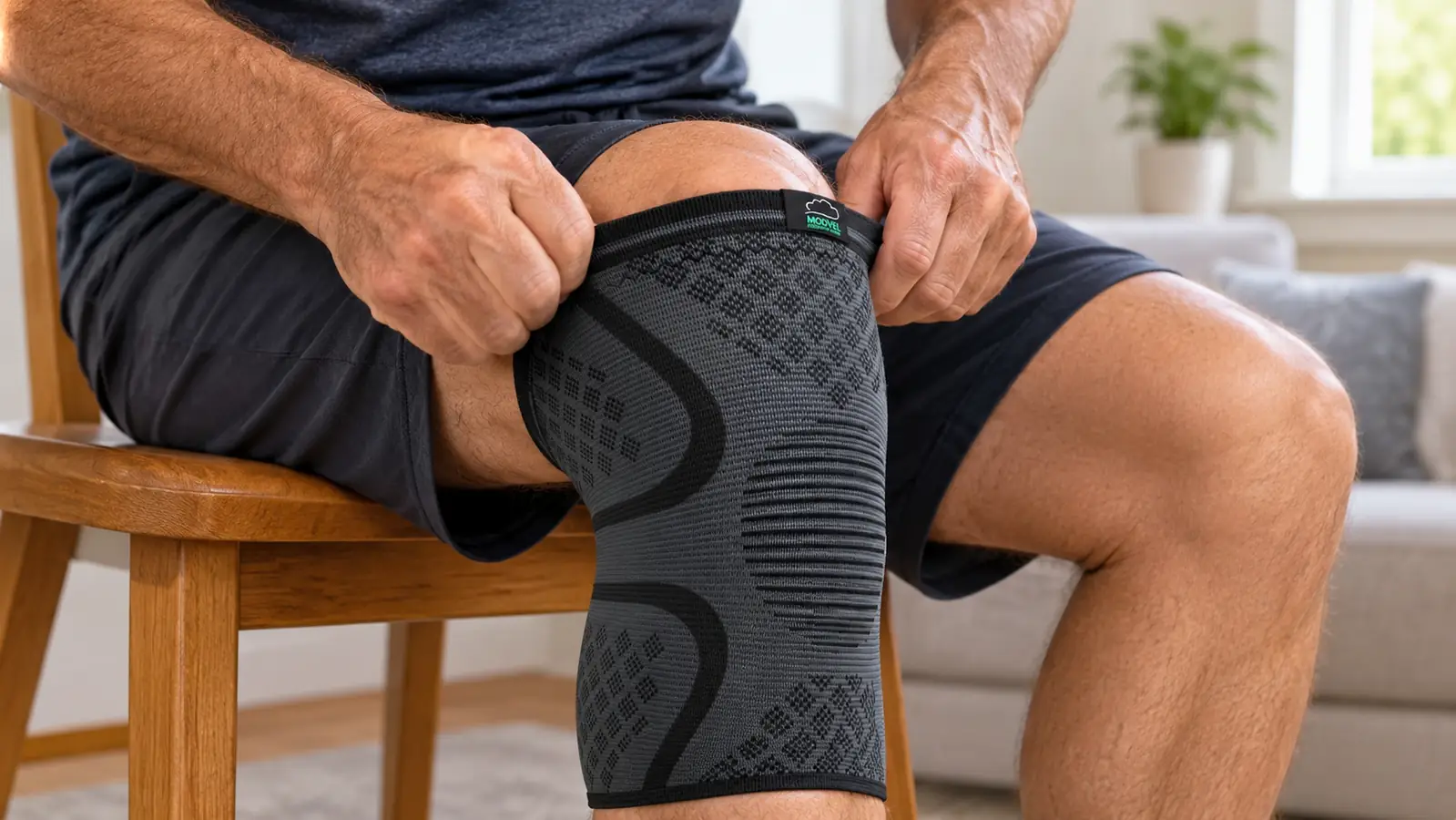
Step 2: Put it on so it sits on the joint, not above it
The mistake I see, and the one I made, is pulling the sleeve up like a sock and stopping when it feels snug. Then the top band sits above the kneecap and the actual knee is getting hardly any of the compression. The point of the 360 degree compression in this sleeve is that it wraps the joint all the way around, and it can only do that if you center the kneecap in the middle of the fabric.
What works for me is this. Sit on the edge of the bed, roll the sleeve up from the bottom the way you would roll a pair of tights, slide your foot through, and work it up your calf and over the knee. Stand up. Bend and straighten a few times. Then reach down and check that there is no bunching behind the knee and no wrinkle pressed into the crease. That crease is where things get uncomfortable if you leave fabric folded into it, and it will make you take the sleeve off before the walk is over.
I put mine on right after my shower while I am still warm. My knees are stiffest in the first twenty minutes of the day, so the sleeve goes on before that stiffness settles rather than after I have already limped down the stairs. If reaching your feet is hard, sit down to do this and use the bed or a chair for balance. Do not attempt it standing on one leg in a bathroom. I know exactly how that ends.
Step 3: Wear it for the task, not for the whole day
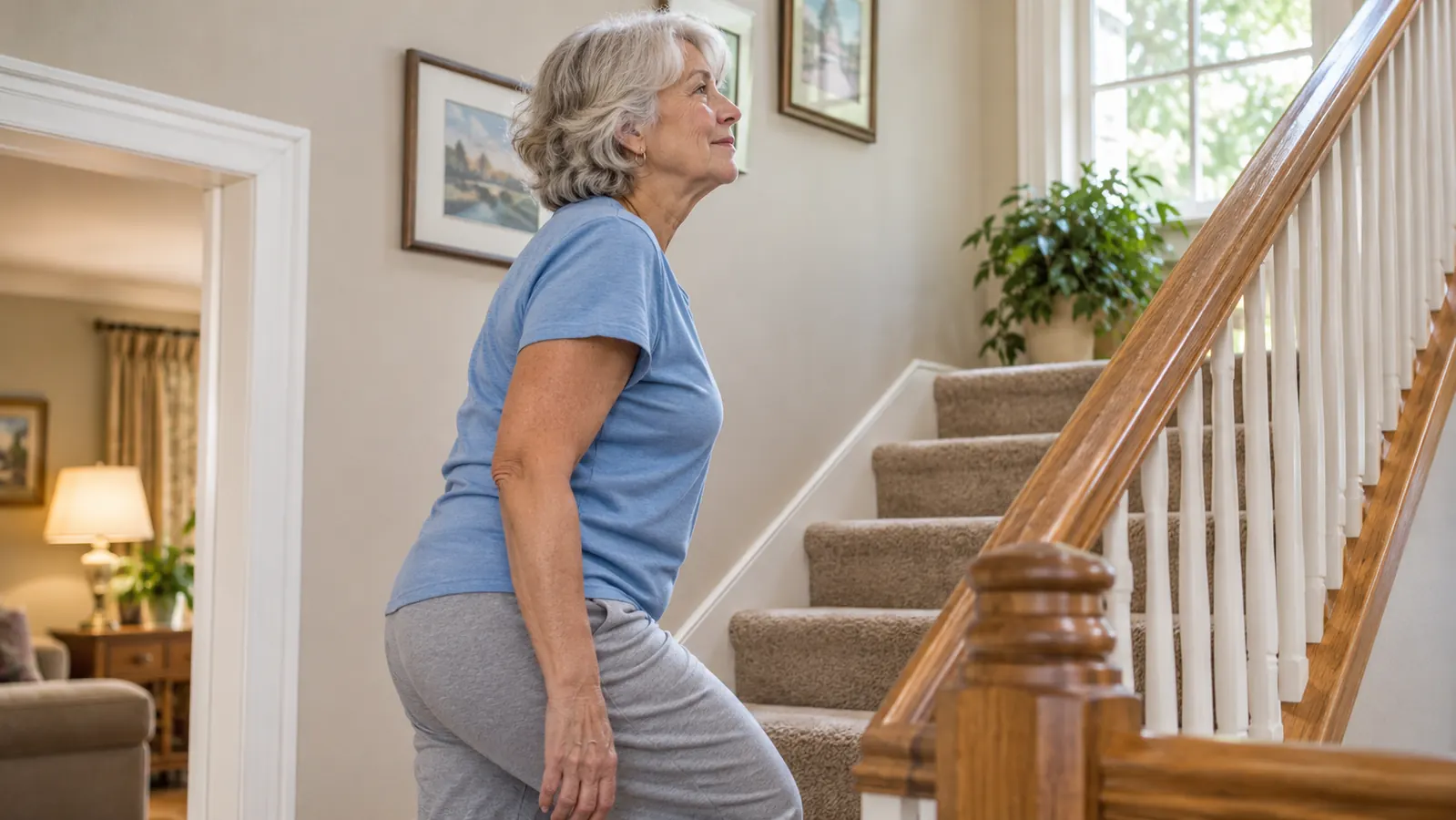
I wear mine for the things that ask something of my knees. The morning walk around the neighborhood. The stairs, and with a two story house the stairs are not optional. The two afternoons a week I babysit, which involve a great deal of getting down onto the floor and back up again. Gardening in the spring, when I am squatting and kneeling and standing and then doing the whole sequence over.
I take it off when I sit down in my recliner with a book. Not because anyone told me to, but because my skin wants a break, and because compression all day every day stops being a support and starts being something my leg is fighting. I do not sleep in mine either. If you are planning to wear one for a long stretch, ask your doctor or physical therapist how long is sensible for you, because that answer depends on your knee and not on mine.
One more note on timing. The sleeve is more useful before the ache than after it. Putting it on once the knee is already angry and puffy is like putting on a raincoat after you are wet. Mine earns its keep when it goes on at the start of the walk.
Step 4: Use it alongside the exercises, not instead of them
Here is where I have to be honest about what a sleeve can and cannot do. It supports. It does not loosen. The stiffness I get in the morning and after sitting is a range of motion problem, and the only thing that has genuinely changed that for me is the home routine my physical therapist gave me. Heel slides on the kitchen floor. Seated leg extensions in a dining chair. Standing up out of a chair without using my hands, ten times, which sounded faintly insulting when she first suggested it and turned out to be hard work.
What the sleeve does is make it easier to get to the exercise. It is easier to walk the block when the knee feels held. It is easier to do the chair stands when I am not already guarding the joint. So the sleeve is not the treatment, it is the thing that keeps me showing up for the treatment. That distinction matters if you are the sort of person who buys a gadget and then expects the gadget to do the work. I am that sort of person. I have a drawer to prove it.
Ask your physical therapist to watch you walk in it if you can. Mine noticed I was still favoring the right leg even with the sleeve on, and gave me a cue to even out my stride. No piece of fabric was going to tell me that.
Step 5: Keep it clean, rotate the pair, and know when to take it off
A sleeve you wear against your skin for a walk gets salty, and a salty sleeve loses some of its grip and starts to smell like a gym bag. I rinse mine in cool water after a few wears and let it air dry flat, and I follow whatever care instructions come with yours rather than my own habits. Do not run it through a hot dryer unless the label says you can. The two pack is doing real work here: one on the leg, one drying on the rack.
The more important instruction is about stopping. Take it off if you feel numbness, tingling or a cold foot, if the skin under it goes red and stays red, or if the knee hurts more with it on than without. A compression sleeve should feel snug and supportive, not tight enough to leave a deep mark. If any of that happens, stop wearing it and call your doctor. That is not a small point. Compression is not a case where more is better.
And a note on materials. The Modvel listing describes a nylon and spandex blend in the material line, and one of the bullet points mentions latex. If you have a latex sensitivity, confirm with the seller before you order rather than after. That is two minutes of your time, and it is exactly the kind of detail I wish I had read more carefully the first time around.
What Else Helps
If I am being straight with you, the sleeve is one item on a short list and not the top one. The top one is the exercises, done on a Tuesday when I do not feel like it. After that it is shoes with actual support instead of the flat slip-ons I wore for years because they were easy to get into. Then it is a chair with arms in the kitchen, so I can push up instead of rocking forward and hoping. Then it is a warm shower before the walk rather than after it.
It also helps to know what the sleeve is not. It is not a substitute for a hinged brace, which is a different tool for a knee that gives way or needs side to side support, and it is not a substitute for the conversation you should have with your doctor if the stiffness is getting worse rather than holding steady. If your knee is further along than mine, a hinged brace may be the more sensible starting point, and there is a comparison of the two on this site worth reading before you decide.
What I would say to anyone in my position is that the goal is not a knee that feels like it did at forty. The goal is a Tuesday where you get down on the floor with a four year old, build the block tower, and get back up without dreading it. That is a smaller goal than the one I started with, and it has been a great deal more reachable.
The sleeve does not make my knee younger. It makes the walk to the mailbox something I do instead of something I negotiate with myself about.
Two sleeves, six sizes, and one less reason to skip the walk
Order with a tape measure in hand, wear it for the task rather than the whole day, and keep the second one clean and ready. Modvel backs the sleeves with a money back guarantee, and the size chart is the thing to read first.
Amazon Check sizes and today's price on Amazon →