

My right knee has been complaining for about six years now. Not shouting, nothing dramatic. Just a low comment on the stairs every morning and a longer one after a walk around the block. I am 67, I have mild to moderate osteoarthritis, and I have spent a fair amount of money over those years on things that were supposed to help and did not.
So when a neighbor handed me a Modvel compression sleeve and told me to try it for a week, I read the Amazon listing before I put it on. Old librarian habit, and a good one. What I found was a nylon-spandex knit, six sizes, two sleeves in the pack, and a listing that weighs the thing in ounces rather than making promises. What I found after a month of wearing one is that a compression sleeve is a smaller thing than the ads suggest and a more useful thing than I expected. Here are ten reasons it earned a spot in my dresser drawer.
The size chart is the first step, not the button.
Six sizes is the reason this works for a wide range of legs. Measure around your kneecap with a soft tape, find your row on the listing, then order. Two sleeves come in the pack.
Amazon See Sizes and Today's Price on Amazon →It wraps the whole knee instead of one sore spot
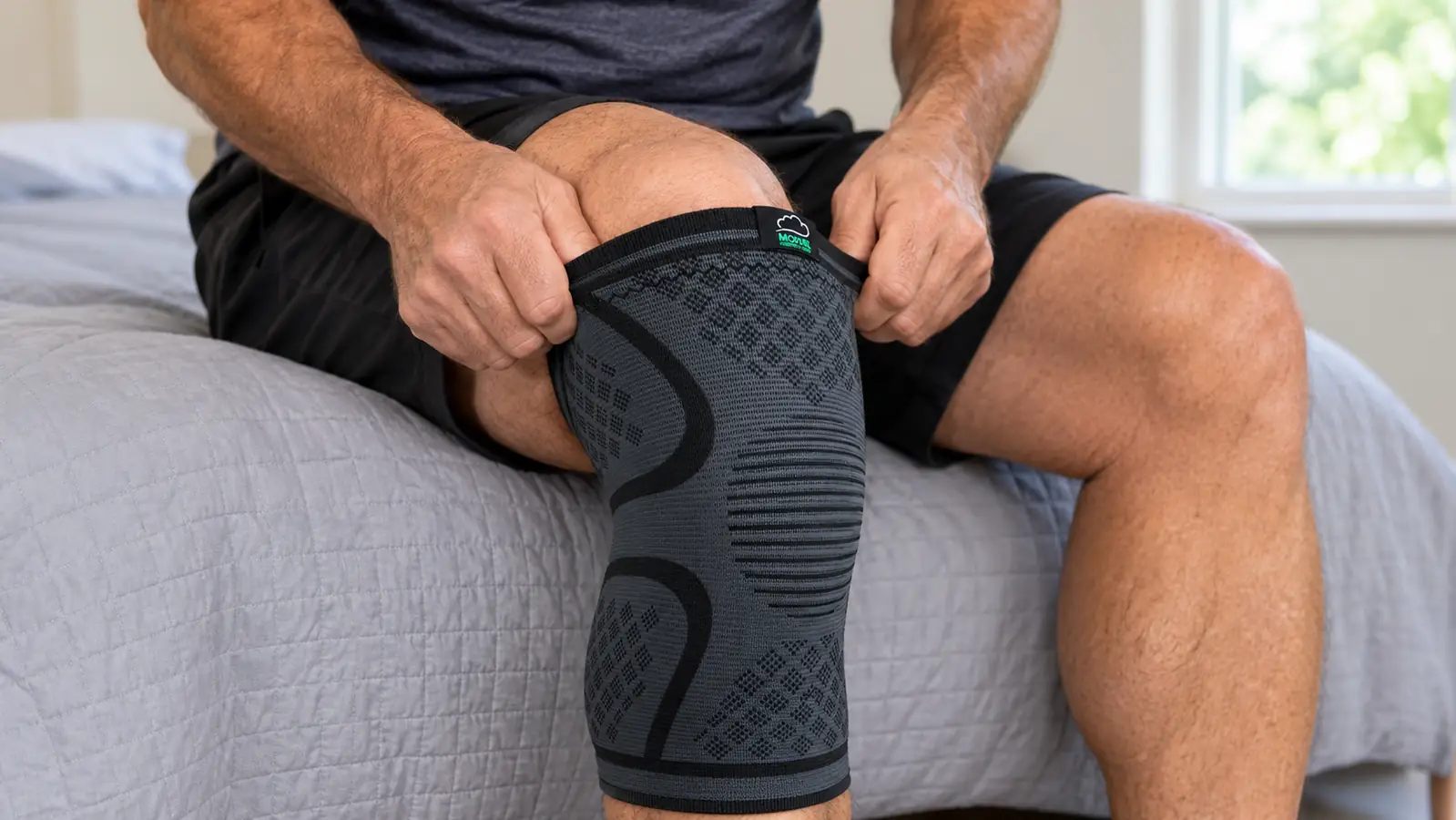
Everything I had tried before this was a strap: a band that pressed in one place and needed adjusting every twenty minutes. The Modvel sleeve is a knit tube you pull up over your foot. The listing calls it 360-degree compression, which sounds like marketing until you wear it for a few days. What it means in practice is that the inside of my knee and the outside of my knee get the same steady pressure, and my hand is not down there fussing with a strap while I am trying to carry groceries in from the car.
It takes the edge off the first ten steps downstairs
My bedroom is upstairs, which means every single day starts with a staircase. Before the sleeve, those first ten steps were a negotiation. I would hold the rail, take them one at a time, and land in the kitchen feeling older than I am. With the sleeve on before I get out of bed, the same ten steps are just stairs again. The stiffness is still there. This is not a cure and it does not pretend to be. It is a smaller, quieter morning, and at my age that is worth something.
It is thin enough to wear under clothes you already own
The listing gives the packed size as about ten inches by six, and under two-thirds of an inch thick. I wear it under jeans and under my gardening trousers and nobody has ever asked me what is on my leg. That matters more than it sounds. A hinged brace is a visible piece of equipment that announces itself. This is closer to a heavy sock, which means I can wear it to church or to the grandchildren's school program without explaining myself to a single soul.
You forget you have it on by lunchtime
The whole sleeve weighs under four ounces, roughly what a pair of reading glasses weighs. The first day I wore it, I kept reaching down to check it was still there. By the second week I had stopped noticing it entirely, including the afternoon I gardened for two hours and only remembered when I got in the shower. Lightweight is not a marketing word in this case. It is the actual reason I keep wearing the thing, because the sleeves and braces I abandoned were all the ones that felt like a chore.
The sizes go wide enough to get a real fit
The listing runs six sizes, from a small sleeve up to a plus size, and that range is the reason this works for me at all. A friend of mine with much thicker calves could never get a drugstore sleeve past her ankle. Before you order, get a soft tape measure, go around your kneecap, and check the chart on the listing. A sleeve that is too loose slides down your leg by noon. Too tight and you will not keep it on past an hour. Measure first and you skip both problems.

Two in the pack means one is always clean
You get two sleeves in the Modvel pack. That sounds like a small thing until you have hand-washed the same one at nine at night because you want it for the morning walk. Now I wear one, the other hangs on the towel bar, and I swap them. They wash in the sink with a little soap and dry overnight. Two is genuinely the right number for a person who wears one most days, and I would not want to go back to a single sleeve now that I have had a rotation.
There is nothing on it to buckle, poke or readjust
No hinges, no stays, no hook-and-loop straps digging into the back of your leg when you sit down. It is a pull-on sleeve and that is the whole of it. I had a hinged brace years ago after a fall, and it did its job, but it was a piece of machinery with a learning curve. This is not that. And I will say the honest thing here: if your knee genuinely gives way under you, this sleeve is not what you need, and I get to that below.
It works alongside your exercises instead of replacing them
My physical therapist gave me a short set of home exercises and I do them most mornings. She was clear that a sleeve supports the knee while you work; it does not do the work. I wear mine during the exercises and it makes the last few repetitions less unpleasant. If you are hoping a sleeve will let you skip the exercises, it will not, and no honest product will tell you otherwise. Ask your own therapist how they want you to use one and follow that, not a stranger's routine.
It comes off and on fast enough that you will actually use it
Sleeve on before the stairs. Sleeve off for the shower. Sleeve on for the morning walk. Sleeve off when I sit down with a book in the recliner. It takes a few seconds each time, so I do not talk myself out of it. Looking back, every thing I stopped using was something that took two hands and a minute of fiddling at the kitchen counter. This one I can put on standing up, which turns out to be the entire difference between a habit and a drawer ornament.
If it does not help, the listing carries a money-back guarantee
I am not going to tell you it will work for you. I do not know your knee, and I am not a doctor. What I know is that the listing states a money-back guarantee, so the experiment has a floor under it. Give it a full week of real use, on the stairs and on your walks, not ten minutes around the living room. If your knee feels no different by the end of it, send it back. That is a reasonable way to find out whether compression is worth anything at all to you.
What I'd Skip
Three things I would skip, and one warning. I would skip wearing the sleeve to bed. It was not designed for that and my knee did not care for eight straight hours of it. I would skip buying it as a substitute for a real brace if your knee actually gives way under you, because a knit sleeve will not stop that and you need to see someone about it properly. Skipping the price-hunting is fine too, since the guarantee covers you either way. The warning is this: the listing mentions latex in the material, so if you have a latex allergy, ask your doctor before you pull one on. And plainly, because it needs saying: I am not a doctor, this is not medical advice, and if your knee is hot, swollen or newly painful, call your physician or physical therapist before you buy anything at all.
The stairs are where I judge everything now. If a sleeve helps on the stairs, it has earned its place in the drawer.
My test was one week of ordinary stairs. Yours can be the same.
Measure around your kneecap, check the size chart on the Modvel listing, and give the sleeve seven normal days before you decide anything. If it does not earn its place in your drawer, the guarantee is there for exactly that.
Amazon Check Today's Price on Amazon →