

My right knee has been grumbling since about 2019. Six years of osteoarthritis, worse on the right, stiffest in the morning and loudest on stairs. I have tried a lot of things that did not work, and the two things that did work were boring: my physical therapist's home exercises, and something to hold the knee while I do them.
Which brings me to the question I get asked most at church and at the garden center: should I get a compression sleeve like the Modvel, or one of those big hinged braces with the metal bars on the sides? I have worn both. My therapist lent me her demo hinged brace for four weeks last spring, and I have been in and out of the Modvel sleeve for over a year. They are not competing for the same job, and once I understood that, the choice got easy. Short answer: if your knee is achy, stiff and cranky but basically stable, a pull-on compression sleeve is the more useful everyday tool. If your knee gives way, or you are coming back from a ligament injury or surgery, you want the hinge and you want a professional fitting it.
The Two Braces, Side by Side
Here is the comparison I wish someone had handed me a year ago. I have kept it to the things that actually changed my mind, not the marketing copy.
| Modvel Compression Sleeve | Hinged Knee Brace | |
|---|---|---|
| What it is | A knit nylon and spandex sleeve you pull on. No straps, no hinges, no metal. | A fabric frame with rigid metal or plastic bars down each side and straps above and below the knee. |
| Main job | 360-degree compression around the joint: warmth, mild support, less swelling feeling after time on your feet. | Mechanical control. It limits how far the knee bends and keeps it from sliding sideways. |
| Everyday comfort | Lightweight and thin enough to wear under trousers. I forget I have it on by mid-morning. | Bulky. Mine rubbed behind the knee and knocked against chair legs. I was aware of it every minute. |
| Stairs and getting up off the floor | Helps, but it does not do the lifting. Four-year-old grandson still beats me to standing. | Genuinely helps on stairs and when rising, because it takes some of the sideways wobble out. |
| Stability if the knee gives way | Not built for it. Compression does not stop a knee from buckling. | Built for exactly this. If your knee has ever folded on you, this is the category you need. |
| Putting it on | Pull it up like a thick sock. Takes about fifteen seconds. Six sizes available, which matters. | Straps, buckles and positioning. Two or three minutes and some fuss. |
| Wearing it all day | Fine. I wear it through a morning walk and a couple hours of gardening. | Not fine, at least for me. After two hours I wanted it off. |
| Sleeping or sitting long | I take it off in my recliner. Anything tight for hours gets uncomfortable. | Never slept in one. Not the point of it. |
| Machine washable | Yes, cold, and I let it air dry. | Depends on the brace. Many come with instructions that amount to hand wash only. |
| Cost | Low enough to buy two in a pack and keep one in the car. | Substantially more, and usually a fitting appointment on top. |
| Who should prescribe it | You can buy one yourself. Fine for general achiness. | Get a physical therapist or orthopedist to pick and fit it. Not a self-serve purchase. |
| Best for | Mild to moderate arthritis, morning stiffness, swelling after walks, keeping the joint warm. | Instability, ligament injury recovery, post-surgical protection, hard physical work. |
Where Modvel Wins
The honest reason the Modvel sleeve won in my house is that I will actually wear it. That sounds like a small thing. It is not. The best brace in the world does nothing sitting in a drawer, and the hinged brace spent most of its four-week trial in a drawer.
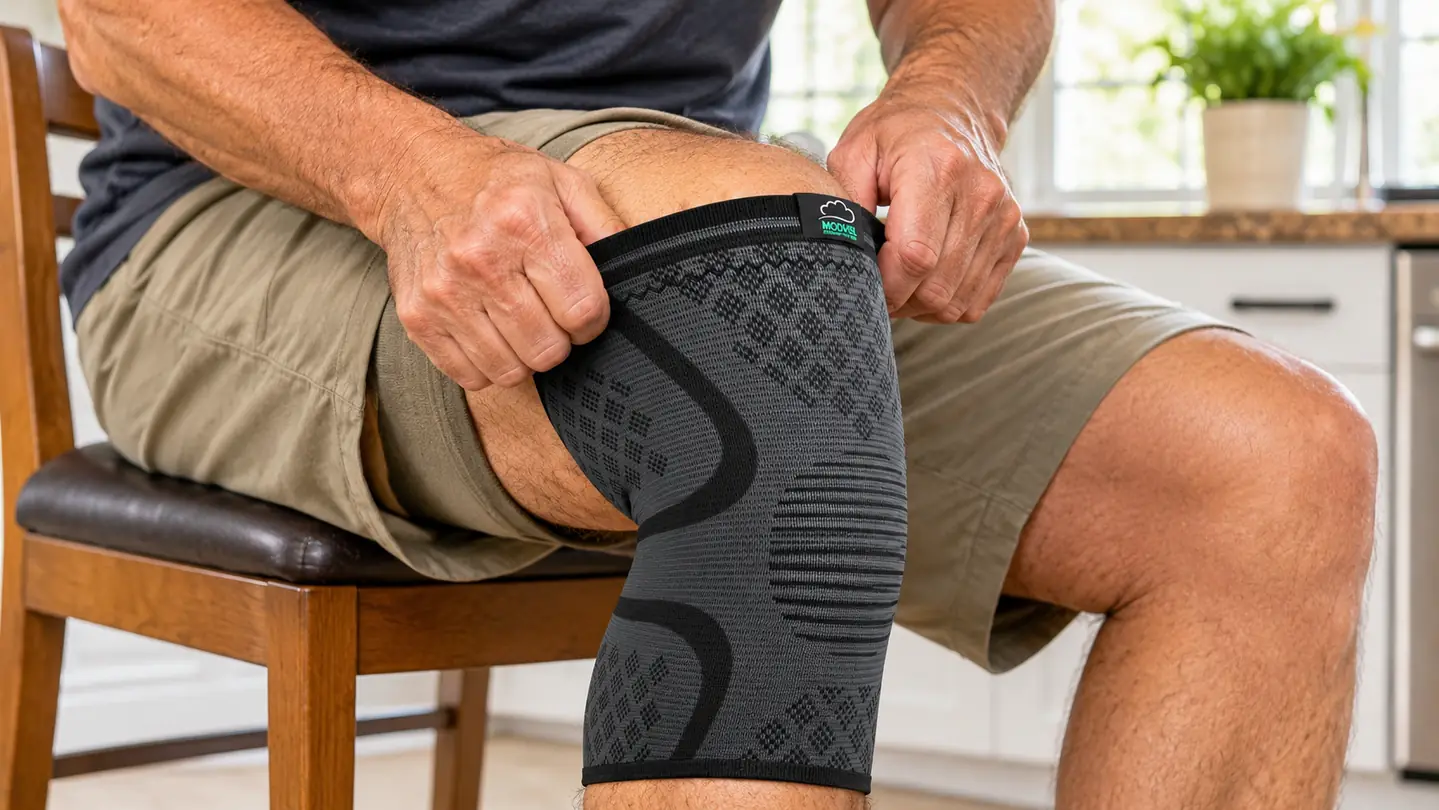
The Modvel sleeve is a nylon and spandex knit that pulls on in about the time it takes to put on a thick sock, and it gives 360-degree compression all the way around the joint rather than squeezing in one spot. On a cool morning my knee feels stiff and wooden until it warms up; the sleeve keeps the warmth in and takes the edge off for the first twenty minutes of a walk.
The week I got serious about it was the second week of April, when the beds needed turning over and I had already put the job off twice. I put the sleeve on at half past eight, went out, and spent forty minutes with a fork and a wheelbarrow. Normally that is a two-session job with a sit-down in the middle and a long look at the sky. I did it in one go, came in, made coffee, and noticed around ten o'clock that I had not thought about my knee once. That is the whole review, really. Not that the ache vanished, because it did not. That I stopped keeping a running tally of it.
I should mention what I tried before this, because it explains why I am particular. I bought a thin elastic sleeve from the drugstore first, and it rolled itself into a rope behind my knee within a block and a half. I spent more time yanking it back up than walking. The Modvel has a wider band at the top and the knit actually holds where you put it, which sounds like nothing until you have walked half a mile with a sleeve migrating down your calf.
It is also thin enough to disappear under loose trousers, which matters if you are not interested in explaining your knee to the woman behind you at the pharmacy. I wear it to the grocery, to the library, and on the two afternoons a week I have the grandchildren. It goes in the machine on cold and I drape it over the back of a kitchen chair to dry, so it is ready again by the next morning.
One thing it will not do, and I want to be clear because this is where people get disappointed. Getting down on the floor with the four-year-old is still a two-handed operation. I go down on one knee, I use the coffee table, and I come back up the same way. The sleeve makes that less punishing the next day. It does not make me twenty years younger, and anything that claims to is selling you something.
The best brace in the world does nothing sitting in a drawer. On a cool Dayton morning I can pull the Modvel sleeve on in fifteen seconds, and that is the entire reason it gets worn.
Where the Hinged Brace Wins
I have to be straight with you, because my therapist was straight with me. For two specific jobs the hinged brace is simply better, and a compression sleeve is not an alternative to it.
The first is stability. If your knee has ever buckled, folded or slid sideways on you, that is a mechanical problem and compression does not fix mechanical problems. The rigid bars along the sides of a hinged brace stop the joint from moving in directions it should not move, and the straps above and below the knee control how far it bends. The second is stairs and rising. That difference was real and I felt it immediately.
Here is the specific moment I knew the brace was doing something the sleeve cannot. My therapist had me go up and down the four steps outside her office while she watched. With the sleeve on, I went up the way I always do: right foot, left foot, right foot, hand on the rail, and a small sideways hitch at the top of every step. With the hinged brace on, the hitch was gone. The knee went where I pointed it. I came down the same way, and for the first time in months I did not come down one step at a time like a toddler on a staircase.
The trade was that I did not want to wear it. It rubbed behind the knee where the fabric bunched, it knocked against the leg of the kitchen table when I sat down, and it did not fit under anything I own except a pair of wide-legged corduroys. After two hours I wanted it off. My therapist said that is the usual report, and it is why hinged braces tend to get worn for a specific task rather than for a whole day of living.
It is also worth saying that a hinged brace is a fitted device and should be picked by someone who knows knees. Mine was sized and the straps adjusted over two visits. I would not buy one off a shelf and hope, and I would not trust a size chart on a screen to get it right.
If your knee is achy and stiff rather than unstable, this is the one I actually wear
The Modvel compression sleeve is the low-fuss option: pull it on, keep the joint warm, wear it under trousers, wash it in the machine. Six sizes, so measure your thigh before you order rather than guessing.
Amazon Check Today's Price on Amazon →
What I Learned About Picking a Size
I ordered the wrong size first. My advice is to take a tape measure to your thigh, four inches or so above the kneecap, and use the sizing chart instead of your pants size. A sleeve that is slightly too small will fight you every time you put it on and leave a red ring behind the knee. One that is too large bunches at the back and slides down your leg by the time you reach the end of the block.
The chart wanted me in a large. I had guessed medium, because I am not a big woman and I assumed a medium was a medium. The medium went on, but it left a mark I could still see at supper, and getting it off after a walk was a small wrestling match on the edge of the bed. The large went on in fifteen seconds and stayed put for a full morning. That is what the chart is for. Six sizes is not marketing noise; it is the reason the thing fits at all, and it is worth five minutes with a tape measure and the back of an envelope.
The two-pack was the right call for me. One lives in the basket by the back door for gardening, and one stays in the glove box for walks that start somewhere other than my own driveway. I have washed each of them more times than I can count and they have held their shape. My husband Gene, who is seventy and has one knee that clicks going up the stairs, borrowed the second one for a week and then asked me to order him his own. That is about as strong a recommendation as you will get from a man who thinks most purchases are a waste of money.
Who Should Buy Which
Buy the Modvel sleeve if your knees are achy, stiff, and puffy after time on your feet, but they hold you up. If your diagnosis is mild to moderate osteoarthritis, if the worst of it is the first twenty minutes of the morning, if you want something you can wear under clothes and forget about, and if you are not looking for a device to keep you safe from falling, this is the sensible everyday choice. It is also the low-cost way to find out whether compression helps you at all before you spend real money on anything else.
What I would tell a friend standing in her own kitchen: buy the sleeve first, wear it for a month on the walks you already take, and pay attention. If the answer is nothing, you have learned something useful for very little money and you can move on to the next conversation with your doctor. If the answer is that mornings are easier and you are not thinking about your knee by the time you reach the mailbox, you have your answer and you can stop shopping. That test cost me one month and settled it.
Buy a hinged brace, and get it fitted, if your knee has given way, if you are recovering from a ligament injury or surgery, if your therapist has told you to limit how far the knee bends, or if you do heavy physical work and need the joint held in line. Do not order one from a screen and guess at the size. Ask at your next appointment, bring the shoe you will be wearing, and let someone watch you walk in it.
And if the answer is both, that is a real answer. I wear the sleeve for walks and gardening and put the hinged brace on for the tasks my therapist flagged. Nothing about this is either-or. Check with your doctor or physical therapist before you add either one, especially if you have circulation trouble, numb feet or a diagnosis you are still working through. Neither of these is a treatment; they are support, and they work best alongside the boring exercises you were given and probably skip on the days you feel fine.
Start with the low-fuss option and see what your knee says
Pull-on compression, six sizes, machine washable, and thin enough to wear under what you already own. Measure your thigh, order once, and wear it on your next morning walk.
Amazon See Sizes and Today's Price on Amazon →