

My right knee has been the loud one for about six years now. Not the kind of pain that stops you cold, the kind that quietly edits your day. You carry the laundry up in two trips instead of one. You sit on the garden bench instead of kneeling in the beds. You do the arithmetic on the staircase before you commit to it. I was diagnosed with mild to moderate osteoarthritis in my early sixties, and I am the sort of retired librarian who reads the whole label before she buys anything. So when I finally ordered the DR. BRACE ELITE Knee Brace with Side Stabilizers and Patella Gel Pads this spring, I had already read the listing twice and the reviews once.
What follows is not a cheer. It is four months of notes. I wore it on my morning walks, on the stairs to the upstairs bedroom, and on the two afternoons a week I keep my youngest grandchild, who is four and treats the floor as a destination rather than a place to pass through. I wore it under trousers to church. Some of it worked better than I expected and some of it I would change, and both are in here, because a review that only has the good parts is an advertisement with a byline.
The Quick Verdict
It stays where I put it, the straps are genuinely adjustable, and the stairs stopped being a negotiation. Four months in, that is worth the two minutes it takes to put on.
Amazon Check Today's Price →Two Minutes of Strapping Beats Ten Minutes of Arguing With the Stairs
Double side stabilizers, a patella gel pad and adjustable straps that hold. I have worn this one twice a day since spring and it has not once slid down my leg.
Amazon Check Today's Price on Amazon →How I've Used It
The routine is simple enough that I have stopped thinking about it. I put the brace on before I come downstairs in the morning, when the right knee is at its stiffest, and I take it off when I settle into the recliner in the evening. Two minutes at most. The first week I fussed with the straps at every wearing, chasing the setting that felt snug without pinching behind the knee. By the second week my hands knew where to stop. That is the honest measure of an adjustable brace: whether your fingers learn it.
My mornings start with a walk around the neighborhood, and that is where a brace either earns its keep or does not. The pull-on sleeves I tried before this always crept down my thigh by the second block, and I would spend the rest of the walk hitching it back up. The DR. BRACE stays where I fasten it. I have walked my usual loop in it four or five mornings a week since spring and I have not once had to stop and fix it in the middle of the sidewalk.
The afternoons with my grandchild are the harder test, because they involve getting down on the floor and back up again more times than any adult should agree to. I wear it for those. I also wear it in the garden, and for the stairs, which in a two-story house are not an occasional event but part of the architecture.
It took me three wearings to work out the order of operations. The brace goes on against bare skin, not over the seam of a trouser leg, and the upper strap wants to sit a hand's width above the kneecap rather than directly on it. The first morning I tried it over jeans I got a crease under the lower strap that rubbed for a solid hour, and I spent the rest of that walk annoyed at myself. Bare skin solved it. The rubber band that comes in the box has never been used in this house, because I have never worked out what it is meant to do, and the brace has never once needed it.
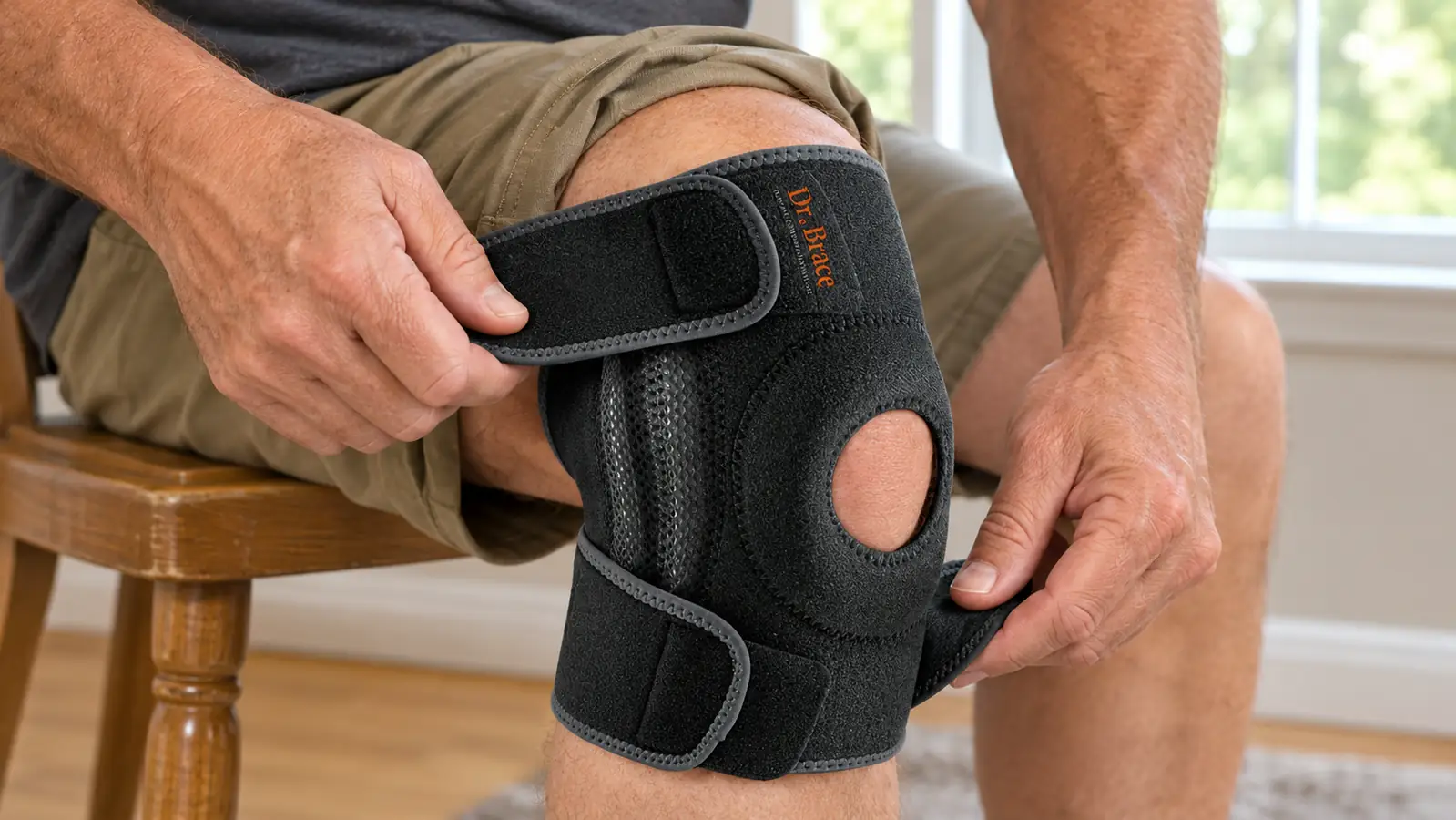
What the Brace Actually Is
The listing is unusually specific about the materials, and I appreciate that in a product. The fabric is nylon 29 percent, neoprene 25.5 percent, polyester 25 percent, spandex 4.5 percent, silicone 3 percent and spring 13 percent. That last figure is the one to notice, because it tells you the side stabilizers are not decorative stitching. There is actual spring in the build, running down either side of the knee joint where you want it.
The listing calls the fabric lightweight and breathable. I would call it mid-weight. It is not the thin slick sleeve you pick up at a drugstore; it has body to it, which is rather the point. On a hot Dayton afternoon it is warm and I take it off when I come inside. In the morning, in April, it is exactly right.
In the box you get the brace, a rubber band, a user manual and a printed weekly exercise program for stronger knees. I read the program. I am not going to tell you it fixed anything, because I am not a physical therapist and neither is a pamphlet. I did take it to my next PT appointment and she went through it with me and crossed out two things she did not want me doing. That is the right use for a page like that, and I would suggest the same.
The Straps, the Stabilizers and the Gel Pad
Three things do the work here, and they work in different ways. The first is the patella gel pad, which sits over the kneecap and gives it a soft place to settle instead of rubbing against ordinary fabric. The second is the double side stabilizers, which the listing describes as fitting snugly around the knee joint. The third is the non-slip silicone strips, and those are the ones I would not give up if you made me choose.
The straps are what people ask me about, because adjustable is a word that gets used loosely in this category. These are real adjustable straps, and the listing claims 360 degree protection during daily use. What that means in practice is that you can snug the top and the bottom separately. My right knee swells a little by evening and I let the lower strap out one notch. That is a small thing that turns out to be a large thing by seven o'clock.
Here is the check I run every couple of weeks to see whether the straps have gone slack. Stand at the bottom of the stairs, put your full weight on the braced leg, and lift the other foot off the floor. Without the brace, my right knee wants to drift inward and the whole leg feels like it is folding under me. With it, the leg holds its line. That is the side stabilizers doing their job, and it is the clearest difference between this brace and every sleeve I have owned. Nothing has gone slack yet.
I will say plainly that a brace is a support, not a repair. It does not change what is happening inside the joint, and nothing you strap to your leg will. What it does is hold the knee in a steadier position and remind me to move in a way that does not make me wince. My physical therapist put it well: it buys you the confidence to do the things that actually help. Check with yours before you decide how long to wear it in a day.
Four Months In
The change I noticed first was not pain. It was decision time. In March I stood at the bottom of the stairs doing arithmetic. By June I was simply going up. That is not the same as being fixed and I will not pretend it is. The ache is still there at the end of a long day, especially if I have been on my feet in the kitchen. But the brace took the dread out of the stairs, and the dread was half the problem.
The second thing I noticed was endurance. My loop around the neighborhood used to end with me favoring the right leg and calculating how far the front door was. Now I finish the loop still walking evenly. I am not going faster. I am going steadier, and steadier is what lets you keep going.
There was a Saturday in early May when I spent close to four hours in the garden, kneeling on a foam pad and getting up more times than I care to count. I wore the brace the whole time. That evening the knee was tired and a little swollen, so I iced it and let the lower strap out the next morning. What struck me was where the tiredness landed. It came at the end of the afternoon rather than the middle. In past springs I would have quit at the two hour mark and left the rest of the planting for another day.
The third thing is wear and tear on the brace itself. Four months of twice-a-day use, and the DR. BRACE has held up. The straps still grip where they should, the silicone strips still catch, and the gel pad has not flattened out. I wash it the way the manual says and let it air dry. It looks like a used brace, which is what it is, but nothing has failed and nothing has stretched out of shape.

The Parts I Don't Love
It is bulky. Under loose trousers nobody knows it is there. Under anything slim it announces itself, and there is a visible ridge where the side stabilizers sit. I have stopped caring, but if you are dressing for something where you would rather not explain yourself, plan around it.
It is warm. Neoprene does that, and the material list is honest about it. On a humid July afternoon the back of my knee gets damp and I want it off. That is a fair trade for the support, but it is a trade, and nobody should tell you otherwise.
One more small thing, and it is genuinely small. Out of the box it smells strongly of neoprene, which is to say it smells like a new wetsuit. That faded inside a week. I hung it over the porch rail for two afternoons and it was fine after that. It is not a reason to send anything back, but if you are sensitive to that smell, know it is coming and air the thing out before the first wearing.
And it takes two hands and a moment of attention to get the straps even. If your hands are arthritic, as mine are on some mornings, that is worth knowing before you order. I sit on the edge of the bed to put it on. Standing up and wrestling with it is how you end up with a crooked strap and a bad mood before breakfast.
What I Tried Before This
Before the DR. BRACE I spent two years in a pull-on compression sleeve. It was inexpensive, it was comfortable, and it rolled down my thigh on every single walk. A sleeve gives you squeeze and not much else. It does not steady the sides of the knee, it does not stay where you put it, and after a while I stopped wearing it, which is the worst thing a support can do.
I also tried an elastic wrap from the drugstore, fine for an hour and a nuisance for a day, and a hinged brace borrowed from my husband Gene that was so rigid I felt like I was wearing a piece of furniture. This one sits between those extremes, with support at the sides and enough give to walk normally. I wrote the longer version of that comparison separately, in the piece on sleeves versus stabilizers, if you want the details.
What I Liked
- Stays in place on walks, no hitching it back up at the corner
- Top and bottom straps adjust separately, which matters when the knee swells by evening
- Double side stabilizers give real lateral support, not just squeeze
- Patella gel pad keeps the kneecap from rubbing against fabric
- Non-slip silicone strips still grippy after four months of daily use
- Comes with a weekly exercise program you can take to your physical therapist
Where It Falls Short
- Bulky under slim trousers, with a visible ridge at the side stabilizers
- Warm on humid days because of the neoprene content
- Takes two hands and a few seconds of attention to get the straps even
- Has a noticeable neoprene smell for the first week out of the box
The silicone strips are the whole difference. Four months of putting it on and taking it off twice a day, and it has not once slid down my leg mid-walk.
Who This Is For
This is for the person who has already tried the drugstore sleeve and found that it rolls, or who has a knee that feels unsteady on stairs and in the garden. It suits mild to moderate osteoarthritis, an old injury that still grumbles in wet weather, and the everyday business of keeping up with a four year old. It suits anyone who wants to put a support on in the morning and forget about it until supper.
It also suits anyone who wants to read the material list before buying. The listing is specific, and in my experience the brace matches what the listing says.
Who Should Skip It
Skip it if you want something you can pull on in the dark without thinking, because this takes two hands and a few seconds of attention. Skip it if you are shopping for something invisible under a fitted dress, or if you run hot and cannot tolerate neoprene in summer. Skip it if you have not had the knee looked at yet, because a brace can mask a problem that deserves a doctor's eyes, and that is not a thing to do to yourself. And skip it if you want the brace to be the whole plan. It is not. The walking, the exercises and the physical therapy are the plan. This is the thing that lets you do them.
Four Months of Notes and One Conclusion
It is not a repair. It is the thing that let me take the stairs, the morning walk and the floor with my grandchild without bracing for them first. If that is what you are after, this one holds.
Amazon Check Today's Price on Amazon →