

I bought my first tube of Voltaren Arthritis Pain Gel at a pharmacy counter, not online, because I wanted to read the back of the box before I decided anything. My right knee has been the bad one for about six years now, mild to moderate osteoarthritis, and the mornings are where it shows. Getting out of bed means standing still for a few seconds and letting the joint decide whether it is going to cooperate today. My husband Gene is seventy and has his own opinions about all of this, most of them involving the phrase you should just take something and stop fussing.
Voltaren is not a pill. It is a gel, diclofenac sodium one percent, and the box describes it as a nonsteroidal anti-inflammatory. The reason I wanted to try it is that a topical goes where I put it instead of everywhere. I had already been down the road of swallowing something and hoping it would land in the right place. What I wanted was simpler than that. I wanted something I could work into my knee ten minutes before I went down the stairs, not an hour ahead of time. That is a smaller ask, and it turned out to be a more useful way to think about the whole thing.
The Quick Verdict
Slow, unglamorous, and the only thing I have tried that makes the first ten steps downstairs cost less. Give it three full weeks before you decide.
Amazon Check Today's Price →One Tube Is a Test. Two Tubes Is Enough to Actually Know.
The two-tube box is what let me judge this fairly, because I had a tube upstairs and a tube downstairs and no excuse to skip a day. Check today's price on Amazon.
Amazon Check Today's Price on Amazon →Why I Bought It and What I Expected
The pitch on the box is not subtle. It says Voltaren is the number one doctor recommended topical pain relief brand, that it is clinically proven to relieve arthritis pain and improve mobility, and that it is an alternative to pills. I am a retired school librarian, which means I spent thirty-one years reading things carefully and I do not take label copy at face value. What I did take at face value was the active ingredient, because diclofenac is a real drug with a real mechanism, and because I had already asked my doctor whether a topical NSAID made sense for me alongside everything else I take. She said yes with the usual caveats. That conversation is the reason I felt comfortable starting at all, and I would not skip it.
What I had tried before this was a rotation of things that all felt productive and mostly were not. A menthol rub that smelled like a Christmas candle and did nothing below the skin. A heating pad that felt wonderful for twenty minutes and then left me stiff again the moment I stood up. Ibuprofen, which did help, but which my doctor and I were both getting uneasy about taking regularly at my age, especially on an empty stomach. And a compression sleeve I wore for a month one summer and could not tell you now whether it did anything at all. The gel was the first thing I tried that was a drug going into the joint area rather than a sensation sitting on top of the skin.
What I expected was something dramatic. That is the honest truth of it. I had read enough reviews to build a picture of rubbing gel on my knee and then walking out to the garden an hour later like a woman in a commercial. What I got was quieter and slower, and for the first two weeks I was fairly sure I had made a mistake. I want to say that plainly up front, because the single largest thing nobody tells you about a topical NSAID is that you cannot judge it over a weekend.
The second thing nobody tells you is that a two pack of one hundred gram tubes is a strange amount to buy on faith. It is one thing to try a single tube. It is another to commit to two. In hindsight the two pack was right for the way I live, because one tube sits on the end table beside my recliner and one lives in the bathroom cabinet upstairs, and having it within reach turns out to matter more than I would have guessed. The tube that is two rooms away is the tube I do not use.
How I've Used It, Day to Day
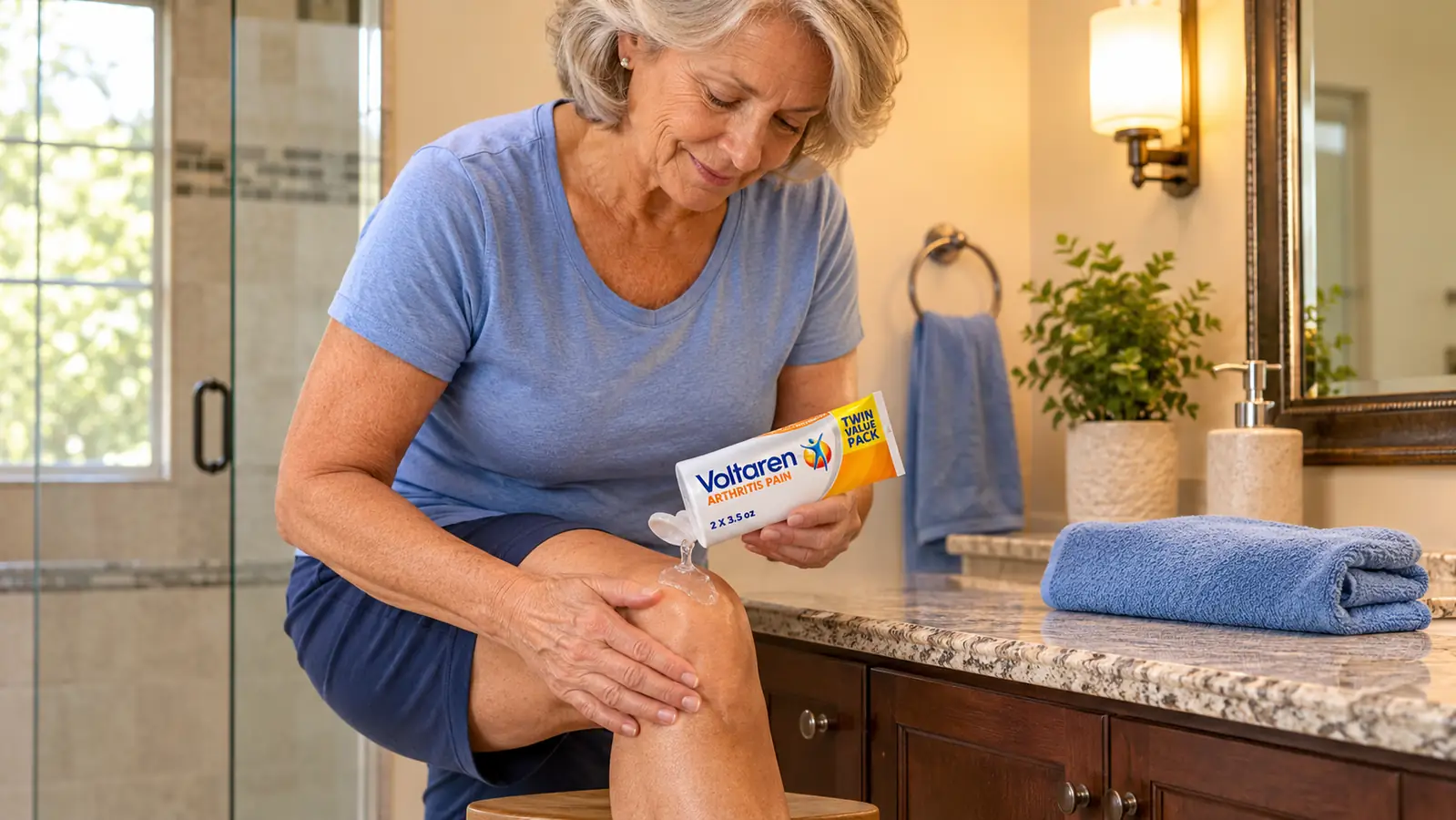
My routine is not complicated and it is not medical advice. It is just what I do. As the label directs, and roughly on the schedule my physical therapist and I settled on, I work a line of gel into the front of my right knee and around the sides before I come down the stairs in the morning. Then I sit on the edge of the bed a minute or two while it dries. If I skip it, I feel it in the fourth and fifth step. If I do it, I mostly do not think about the stairs at all, which is the entire point. I do the same thing before my walk around the block and before I get down on the floor with my youngest grandchild, who is four and believes all adults should be available at floor level.
The tube has a flip cap, which sounds like a small thing until you are trying to open it one-handed while the other hand is holding onto the bathroom counter. The gel goes on cool and dries down in a couple of minutes. It does not leave my skin feeling slick under trousers, which mattered more than I expected, because I am not going to stand in a cold bathroom waiting for my knee to be dry enough to get dressed. I wash my hands immediately afterward, every single time. A topical NSAID on your hands is a topical NSAID that ends up somewhere you did not intend, and I learned that lesson years ago with other creams.
There are fourteen steps between my bedroom and the kitchen. I know because I counted them one morning in February when I was trying to work out whether the gel was doing anything measurable or whether I was simply in a better mood about it. Fourteen steps, and for one week I took them one at a time with my hand on the rail, and then a week after that I came down them like a person going to make coffee. That is not a scientific measure and I am not offering it as one. It is the measure I had, and it is the reason I kept going instead of putting the tube in a drawer.
Consistency is where people get sloppy, myself included. The first month I was disciplined. The second month I got busy with the garden and the grandchildren and started missing applications, and then I could not figure out why my knee had gotten worse. It was not mysterious. When I follow the directions and keep to the schedule I was given, the gel does its job. When I freelance, it does not. That sounds obvious written down. It took me a month to notice, and it is the whole reason I think a lot of the people who say this does nothing simply did not use it long enough to find out.
Three weeks in, the honest answer was that it did not make my knee new. What it did was make the first ten steps downstairs cost less, and that is worth something when you are sixty-seven and the stairs are not going anywhere.
What It Actually Helped With
Here is my honest accounting after about five months. The morning stiffness is better. Not gone, better. The first ten steps downstairs cost me less than they did last winter, and that is a change I can feel rather than a change I have to talk myself into. Stairs in general are less of a project than they were. Standing up from my recliner after an hour of reading used to involve a small negotiation with the knee. Most days now it does not.
The garden is where I noticed it most. I am on my knees in the dirt in May and June, and last year that meant an evening of aching and a rough morning after. This spring I planted a bed of beans, got up, walked to the shed, came back and knelt down again, and the aftermath was milder than it has been in years. Milder is not the same as absent and I want to be careful not to oversell. If you are looking for a tube of gel that makes osteoarthritis go away, that tube does not exist and this is not it.
There is one afternoon I keep coming back to. My youngest grandchild had a birthday party at a park in April, the kind with a climbing frame she expects every adult to be inspected on, and I got down on the ground beside her twice without having planned the second time. Two years ago I would have done it once, spent the rest of the afternoon in a lawn chair, and been sore for two days afterward. That afternoon I was sore for one evening. It is a small difference and I would not have called it small at the time, standing in the kitchen afterward rinsing out a thermos.
What it did not help with is the deeper ache that settles into the whole leg after a long day on my feet. It also did nothing for the grinding sensation when I stand up out of a low chair. Those are structural things and no cream is going to change them. My physical therapist was blunt about that and she was right. The gel buys me comfort around the joint. The exercises she gave me do the rest of the work, and I do them most days, grudgingly and not especially well.
What I Liked
- Nothing to swallow, which matters if you already rattle when you stand up
- You decide where it goes, which means the knee and not the stomach
- Dries down in a couple of minutes and does not leave my skin slick under clothing
- The flip cap is genuinely one-handed
- Labeled for whole-body use, so I also use it on my hands after weeding and on a shoulder I slept on wrong
- Two one hundred gram tubes, one upstairs and one down, means I actually stick with it
Where It Falls Short
- It is slow. Two weeks in I was convinced I had wasted the purchase
- You have to keep applying it, and the days you skip are the days it stops helping
- It is still an NSAID, so anyone on other medication needs a doctor's sign-off first
- It does nothing for the mechanical grinding, only the ache around it
- Easy to talk yourself into using more than the directions say, which is not how it works
The Things Nobody Mentions
Two things I did not read in any of the reviews I plowed through before buying. First, the label covers whole-body use and not just knees, so I have started using it on my hands after a long afternoon of weeding and on the back of my shoulder when I have slept badly. That is a wider use than I bought it for and it has made the two pack feel less like a gamble. Second, the flip cap matters more than the product photos suggest. You will not care about that until you are alone in the bathroom at six in the morning holding onto the towel bar with one hand.
What nobody mentions, and what I think matters most, is the waiting. A topical NSAID is not a numbing agent. It does not do anything in ninety seconds. For the first twenty minutes after I apply it, I am mostly aware that I applied it and not much else. The effect, for me, builds over days of steady use rather than minutes. If you are the sort of person who gives up on something after two applications because you did not feel a tingle, you will give up on this and then tell everyone at church that it does not work.
One practical note about cold mornings, because nobody warned me. In January I was applying it and then standing in the bathroom waiting for my knee to dry before I could pull on trousers, which is a minute or two I could have spent making coffee. I started applying it first, before I brushed my teeth, and by the time I was finished the gel had dried down and I was dressed and halfway to the kitchen. It is a small adjustment and it is the reason I still bother on the days I am running late for a morning walk with the neighbor.
The other unglamorous thing is that you have to be sensible with it. It is a drug. It sits on your skin rather than in your stomach, which is exactly why I prefer it, but it is still diclofenac and the box still says NSAID. People in my age bracket are usually on four or five other prescriptions, and the interactions that matter with an NSAID do not disappear because the delivery method changed. My doctor knows I use it. That is not a formality and it should not be one for you either.

Where It Falls Short
The gel is not fast, it is not dramatic, and it does not touch the mechanical part of the problem. It also cannot rescue a bad day. There are mornings, usually when the weather has turned, when my knee is simply going to be sore and a tube of anything is not going to change that. On those days I use it anyway, I take the stairs one at a time, I am slower, and I have made my peace with the fact that a topical is one tool and not the whole toolbox.
It is also easy to overdo. When something helps a little, the temptation is to decide that more must help more, and that is not how this works. I asked my physical therapist about that directly and her answer was to follow the directions and not get creative. I am passing that along because I needed to hear it. Nobody in the review section of anything is going to tell you to use less of the thing they are recommending, so consider this the rare exception.
Who This Is For
This is for the person with mild to moderate knee osteoarthritis who wants to try a topical before or alongside oral medication, who is willing to be consistent for three or four weeks before forming an opinion, and who is going to talk to a doctor first. It suits people who are still mobile, still gardening or walking or getting down on the floor with a grandchild, and who would like the knee to be a slightly smaller topic of conversation in their house. The two hundred grams in the two pack is a fair amount to form an opinion on, which is more than I can say for a single tube.
Who Should Skip It
Skip it if you have ever reacted badly to diclofenac or any other NSAID, if you take blood thinners, or if you have kidney or heart problems and have not cleared it with a doctor. Skip it if you are pregnant. Skip it if you want something that works in five minutes, because it will not, and you will spend a month being disappointed by something that was never promising speed. And skip it if what you actually need is a diagnosis. I spent years assuming my knee pain was one thing before I had it properly looked at, and a gel is a comfort measure, not a substitute for knowing what is going on inside the joint.
If You Are Going to Try It, Try It Long Enough to Tell
Three weeks of steady use is a fair trial, and the two-tube box is what makes steady use possible. Ask your doctor first, then give it that long before you decide.
Amazon See Today's Price on Amazon →