

The stairs in our house are ordinary. Thirteen steps, a railing on the right, a landing halfway up. For most of my life I went up and down them without thinking. Then about six years ago my knees started to make themselves known. The right one is worse. It is stiff when I get out of bed, achy after a long walk, and grumpy on cold mornings. I am 67, a retired school librarian in Dayton, Ohio, and I have mild to moderate osteoarthritis. I am not looking for a quick fix. I am looking for a way to keep babysitting my grandchildren, puttering in my garden, and sleeping in my own upstairs bedroom without dreading the staircase.
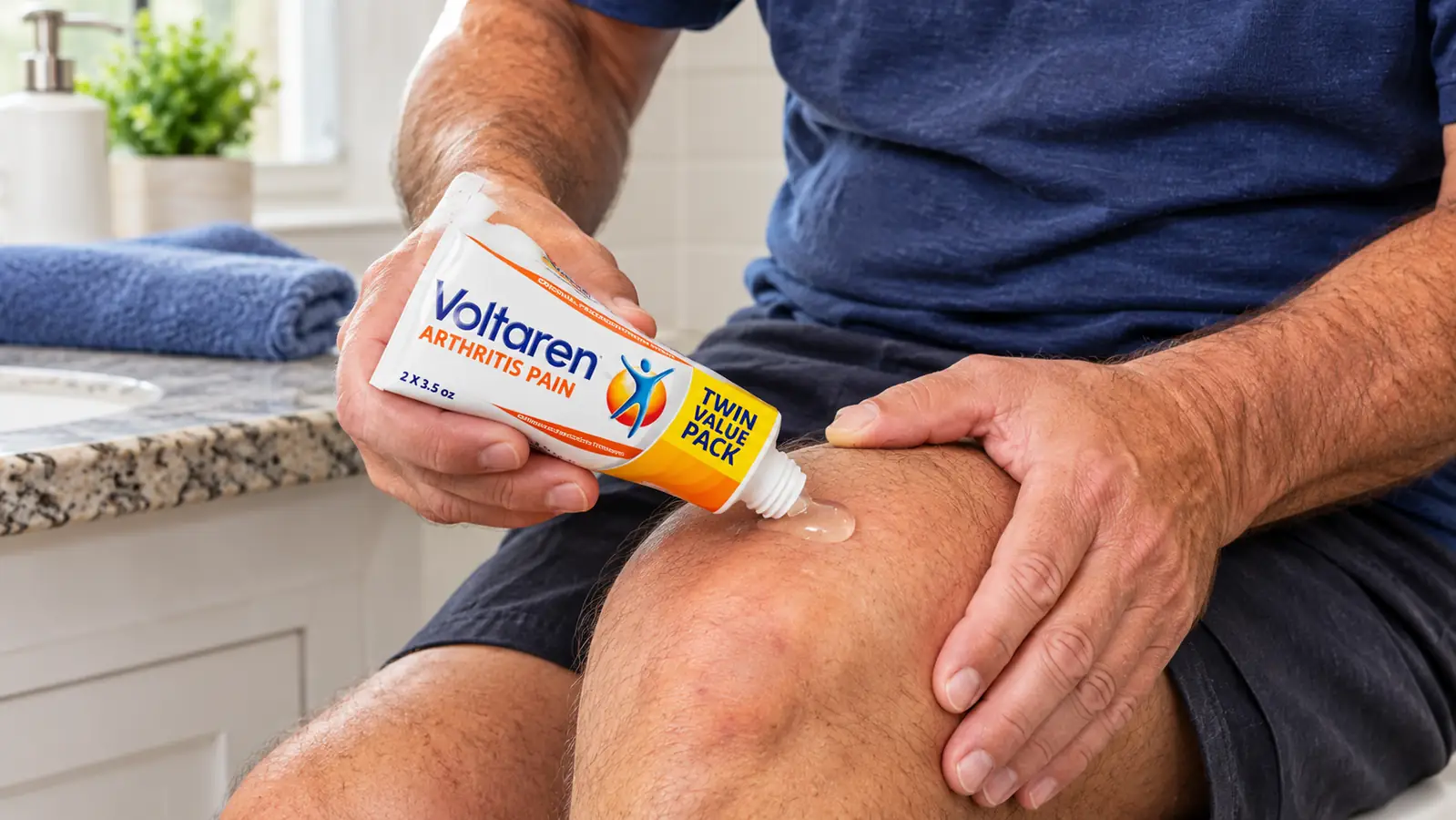
I read labels. That is the librarian in me. When I decided to try a topical option, I started with Voltaren Arthritis Pain Gel because it was the one my doctor mentioned and the one I kept seeing on the shelf. The package I bought held two 100 g tubes, 3.5 oz each, and the active ingredient is diclofenac sodium 1%, equivalent to 0.93% diclofenac. It is a gel, not a pill. I used it for several months on my right knee, while I kept doing the home exercises my physical therapist gave me. This is what happened, including the parts that did not impress me.
The Quick Verdict
A topical gel that earned a permanent spot in my routine. It helps me move more comfortably, but it does not replace my exercises or my doctor.
Amazon Check Today's Price →The tube I reach for before the stairs, not after
Voltaren Arthritis Pain Gel is the topical option I tested on my right knee for several months. It comes as a gel in two 100 g tubes, and the label lists diclofenac sodium 1% as the active ingredient. If you have been looking for an alternative to pills, this is one to ask your doctor about.
Amazon See Current Availability on Amazon →How I've Used It
I kept one tube by my toothbrush upstairs and one in a basket by the back door. That sounds fussy, but it made the habit easier. I used the gel as directed on the package, most mornings, and again at night when the day had been long. I rubbed it into the front and sides of my right knee, washed my hands, and went on with my day. I did not stop my exercises. I did not stop walking. I did not expect the gel to do the work of both. For the first couple of weeks I mainly noticed that I was remembering to use it, which is not the same as feeling a difference.
The flip cap is a small thing that turned out to matter. When my hands are stiff in the morning, I do not want to fight a screw top. The tube is easy to pick up, easy to close, and easy to keep in a drawer. I also liked that it is a gel. It goes where I put it. I rub it in until it is gone. There is no patch to peel off and no pill to swallow. That is not a medical advantage. It is a practical one. I am more likely to stick with something that takes less than a minute.
My routine settled into something I could repeat. Up at six-thirty, gel on the right knee, hands washed, then down the stairs for coffee. A pea-sized amount covered the front of the knee and the sides. Any more than that and it just sat there waiting to be rubbed in. On the days I babysit, I put a second application on around noon, before my granddaughter arrives and the floor work starts. The first week I put a piece of masking tape on the cap so I would not lose track of whether I had done it that morning.
What Voltaren Is and What It Is Not
Voltaren Arthritis Pain Gel is a topical NSAID gel. The label lists diclofenac sodium 1% as the active ingredient, equivalent to 0.93% diclofenac, and lists arthritis, joint pain, and muscle pain as specific uses. It also lists whole body as the target use body part, though I only used it on my knee. The package calls it an alternative to pills and says it is the number 1 doctor recommended topical pain relief brand. It also says it is clinically proven to relieve arthritis pain, improve mobility, and reduce stiffness, aches and pains. I am quoting the label there, not adding my own promise.
What it is not: it is not a heating pad, a brace, or a replacement for exercise. It does not change the joint itself. It does not rebuild cartilage. It does not make me forget I have arthritis. It is a gel in a tube that I rub into my knee, and it helps me feel more comfortable when I move. That is a modest thing, and I mean that as praise. Modest things are what I can actually use. If you want a product that erases the problem, this is not that. If you want a topical option to discuss with your doctor, this is a reasonable one to look at.
The First Month, in Plain Terms
Week one was uneventful. I put the gel on. I went about my day. I did not feel anything dramatic, and I was glad of that. I have tried enough things that promised a sudden shift and delivered a rash or a stomach ache. By day ten I noticed something smaller. The first three steps in the morning felt less like a negotiation. I still felt the stairs. I just did not have to psych myself up for them. That is the kind of change I trust, because it is the kind I can describe without reaching for a superlative.
By the third week I could stand at the kitchen sink and wash a sinkful of dishes without shifting my weight every thirty seconds. That sentence sounds small. It was not small to me. I had gotten used to leaning on the counter with one hip while I rinsed a plate. I had gotten used to doing dishes in shifts. One evening I finished the whole stack and realized I had not thought about my knee once. I was not pain-free. I was less aware of my knee, which is a different and more useful thing.
There was one morning I still think about. It was the last week of that first month, cold and gray, and Gene had stacked a pile of library books by the front door for me to return. I carried them down the stairs in one trip instead of two. I did not plan it. I just did it. Twenty years ago that would not have been worth mentioning, and that is exactly why I mention it now.
By the third week I could stand at the kitchen sink and wash a sinkful of dishes without shifting my weight every thirty seconds.
How It Fits Into a Normal Day
My days are not dramatic. I walk most mornings around the neighborhood. I keep a small vegetable garden. I babysit two afternoons a week, which means getting down on the floor with a four-year-old and getting back up again. The gel fits into the edges of those days. I put it on before I go out. I put it on before I babysit if my knee is talking to me. I put it on at night if I have been on my feet. I do not carry the tube in my pocket. I keep it where I will see it, because out of sight is out of mind for me.
The floor work is the real test. Getting down is not the problem. Getting up is. My granddaughter is four and she likes to build with blocks on the living room rug, which means I am down there for twenty minutes at a stretch and then I have to stand. I started putting the gel on about half an hour before she arrives, and the standing-up part got a little less grim. Not effortless. Just less grim.
The two-tube pack suits the way I live. One tube stays upstairs, one stays downstairs. I have never run out in the middle of a morning, which sounds like a low bar, but low bars are the ones I trip over. The tube is 100 g, 3.5 oz, and the two together are listed at 7.06 ounces. It is not a travel-sized thing. It sits in the bathroom cabinet or the kitchen drawer and waits. I like that. I do not need another gadget. I need something I can reach without a scavenger hunt.
I also noticed the limits. The gel did not help on the day I spent three hours standing at a church rummage sale. It did not help the morning after I decided to prune the hedge without kneeling on a pad. It did not make my left knee better, because I was not using it there. It is not a force field. It is a tool I use on my right knee, and it works best when I also use the tool I already have, which is my exercise routine.
I also learned to time it. I put the gel on before the activity, not after, because afterward I am usually ready to sit down. That is not a rule from the label. It is just what works for me. I put it on before my morning walk and before I get down on the floor with my granddaughter. Then I forget about it. The forgetting is the point. A good tool should not become another thing to manage.

The Tradeoffs I Noticed
The first tradeoff is time. A pill is faster. A gel takes a minute to rub in, and you have to remember to do it. I am retired, so a minute is not hard to find. When I was working, I might have been less consistent. The second tradeoff is expectation. I wanted the first week to feel like something. It did not. The change came slowly, in small moments, and I had to pay attention to notice it. The third tradeoff is the label. It has warnings. Read them. I am not a pharmacist, and I am not going to pretend the warnings do not matter.
The fourth tradeoff is honesty about what a topical gel can do. It can take the edge off. It can make a stiff knee feel less stiff. It cannot make a worn joint new. It cannot replace the exercises that keep my leg strong. It cannot tell me when to stop. I still have to do that. I still have to check with my doctor before I add something new, especially because I take other medications. That is not a flaw in the product. That is just the truth of managing arthritis at 67.
I also wish the tube told me how much was left. It gets flat and creased as you work through it, and you genuinely cannot tell whether there is one more week in there or one more day. I started keeping the spare in the closet and pulling it out when the first one began to feel light. That is a complaint about packaging, not about what is inside.
One more thing. The tube is not invisible. It sits on the counter and reminds me. I have friends who would rather keep their arthritis out of sight. I understand that. I used to be the same way. Now I would rather see the tube and use it than pretend my knee is fine and pay for it at bedtime. That is not a product feature. It is a change in how I think.
What I Liked
- Easy to apply as a gel from a tube, with a flip cap that is simple to open.
- Contains diclofenac sodium 1%, the active ingredient listed on the package.
- Labeled as the number 1 doctor recommended topical pain relief brand.
- Clinically proven, per the label, to relieve arthritis pain and improve mobility.
- Two 100 g tubes in the pack, so one can stay upstairs and one downstairs.
Where It Falls Short
- Not instant. It took me weeks to notice a difference.
- Requires daily consistency, which is harder than taking a pill.
- Does not replace physical therapy, exercise, or a doctor's advice.
- The label includes warnings that must be read, especially if you take other medications.
- It is still a gel you have to rub in, not a set-and-forget patch.
Who This Is For
This is for the person who wants a topical option and is willing to use it consistently. If you are in your fifties or older, if your knees are stiff and achy from osteoarthritis or old injuries, and if you have already talked with your doctor or physical therapist about what is safe for you, Voltaren is worth a look. It suits people who like a routine, who read labels, and who do not expect a tube of gel to do the work of a whole plan. It also suits people who want an alternative to pills, which is how the package describes it.
Who Should Skip It
Skip it if you want a product that works in five minutes and never asks anything of you. Skip it if you will not read the warnings or ask your pharmacist about interactions. Skip it if you have had a reaction to an NSAID or if your doctor has told you to avoid them. Skip it if your knee is hot, very swollen, locking, or giving way. Those are reasons to see a doctor, not reasons to buy a gel. And skip it if you think it can replace physical therapy. It cannot. I tried that math in my head, and it did not work.
A fair tool for a knee that still has work to do
I still use Voltaren Arthritis Pain Gel on my right knee, and I still do my exercises. If that sounds like the kind of routine you can live with, look at the current listing and talk it over with your doctor or pharmacist first.
Amazon See Current Availability on Amazon →