

Here is the short answer, the one I would have wanted six years ago when my right knee first started complaining on the stairs: Voltaren Arthritis Pain Gel and a menthol rub are not competing versions of the same thing. One is a counterirritant that gives your knee something else to feel. The other is diclofenac sodium 1%, a topical NSAID in gel form, and it is aimed at the inflammation side of arthritis rather than the sensation side. If your knees are stiff and achy from osteoarthritis, that distinction is the whole decision.
I am not a doctor and I am not going to pretend to be one. I am 67, a retired school librarian in Dayton, Ohio, with mild to moderate osteoarthritis, worse on the right side, diagnosed about six years ago. I have used both kinds of product on the same knee for long enough to have an opinion with some mileage on it. What follows is what I noticed, what the labels actually say, and which one I would hand to a friend who asked. Anything about your own medication list goes to your doctor or pharmacist, not to me.
| Voltaren Arthritis Pain Gel | Menthol Pain Rubs | |
|---|---|---|
| Active ingredient | Diclofenac sodium 1%, a topical NSAID, in a gel base | Menthol, often with camphor or methyl salicylate, in a cream or ointment base |
| How it acts on the ache | Aims at inflammation in and around the joint | Cools or warms the skin so the ache is less of what you notice |
| Arthritis claim on the label | Clinically proven to relieve arthritis pain, improve mobility and reduce stiffness, per the manufacturer | Sold mainly for sore muscles and achy joints, not measured over weeks in an arthritis trial |
| How fast you notice it | Not a first-minute product. It builds with regular use | Sensation within a few minutes of rubbing it in |
| How often you can apply it | The label sets an application schedule and a limit, and the limit matters | Reapply as often as you like, whenever the knee starts talking |
| If you already take NSAIDs or a blood thinner | It is an NSAID, so it counts toward your total. Ask your doctor or pharmacist first | No NSAID in it, so there is nothing to reconcile with your pill box |
| Residue on clothing | The gel sinks in and leaves no film I noticed, no marks on trouser legs | The rub stays on the surface and transfers to clothing and sheets |
| Smell | Faint, gone in a few minutes, nobody at church has ever mentioned it | Strong and long lasting, and it works its way into fabric |
| What you get | Two 100 g tubes with an easy flip cap | Varies by brand, usually one jar or tube |
| Best for | A daily arthritis ache in a knee or hand that you want to work on over weeks | A sore muscle after gardening, or a bad afternoon when you need something now |
How They Work Differently
A menthol rub is what the labels call a counterirritant. Menthol, usually with camphor or methyl salicylate alongside it, sets off a cooling or warming signal on the skin that competes with the ache underneath. It does not change anything inside the joint. It changes what your brain is paying attention to, and for twenty minutes after a long walk that can be genuinely welcome. I am not being dismissive about it. Distraction is a real thing and it works.
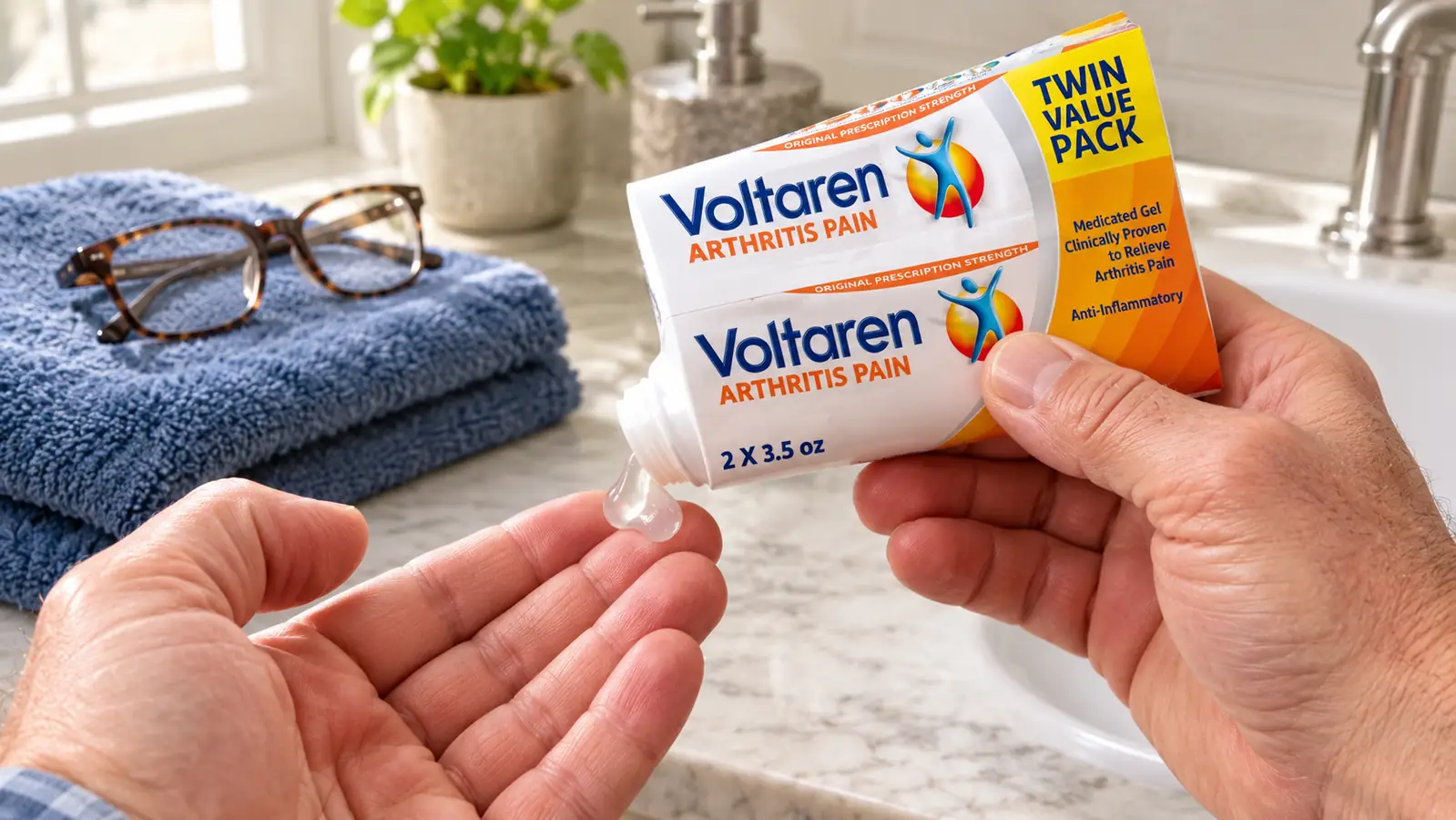
Voltaren is doing a different job. The active ingredient is diclofenac sodium 1%, which is an NSAID, and the gel carries it through the skin toward the joint rather than just sitting on the surface. The listing describes it as clinically proven to relieve arthritis pain, improve mobility and reduce stiffness. That is the manufacturer's claim on the package and you should read it yourself rather than take my word for anything. But notice what it is a claim about: arthritis, specifically, measured over time. That is not a sentence you will find printed on a jar of menthol rub.
The tradeoff is timing, and it is the reason people give up on the gel too soon. A rub tells you something within a minute or two. Diclofenac does not, because it is not built to. It accumulates with repeated use and the label carries an application schedule you are meant to follow rather than exceed. If you want something that works right now while you are standing at the bottom of the stairs working up to the first step, the gel will disappoint you. If you want something working on the joint across a couple of weeks, no rub was ever going to do that.
Here is the test that settled it for me. One Saturday morning I put both products out on the kitchen table with my reading glasses and went through the fine print line by line, which is the sort of thing a retired librarian does for entertainment. The menthol jar listed its ingredients and then a short warning about heat and broken skin. The Voltaren box put diclofenac sodium 1% at the very top and then ran a whole column of questions underneath about other medicines I might be taking. I sat back and thought that anything with that many questions attached is either dangerous or actually doing something. It turned out to be a bit of both, which is exactly why the questions are printed there.
The active ingredient is diclofenac sodium 1%, an NSAID. That is the entire difference. A menthol rub does not have one, and no amount of warming sensation changes what is happening inside the joint.
Where Voltaren Wins
Voltaren wins on the thing that actually sent me looking in the first place, which is a joint that has been aching for weeks rather than a muscle that is sore for an afternoon. The label talks about arthritis pain, mobility and stiffness. It is the number one doctor recommended topical pain relief brand, which is the sort of line I usually roll my eyes at, except that my own doctor brought it up before I did. It is also an alternative to pills, and for somebody who already rattles when she stands up, one fewer thing to swallow is not a small thing.
The practical side matters more than people expect. The gel sinks in and dries without a film, so I am not leaving grease marks on the arm of the recliner or on my good trousers. The flip cap is easy on arthritic hands, which sounds trivial until you have fought with a screw top at seven in the morning. And the pack gives you two 100 g tubes, so one lives in the bathroom cabinet and the other in the drawer beside my bed, which means I am not hauling anything up and down the stairs my knee already resents.
Where Menthol Rubs Win
A menthol rub wins on speed and on freedom. You feel it almost immediately, and you can put more on whenever you like without consulting a schedule. There is no NSAID in it, which matters enormously for anyone whose doctor has already told them to be careful with that family of drugs, or who is on a blood thinner, or who simply does not want one more thing interacting with the six prescriptions already on the counter. That is not a small advantage. For some people it is the deciding one.
It also wins on the ordinary aches that are not arthritis at all. The afternoon I spend on my knees in the vegetable garden pulling up the last of the beans is a muscle complaint, not a joint one, and the rub is the right tool for that. The smell is strong, and I happen to like it, though Gene has opinions. And there is the four o clock problem: when the knee starts in at the end of the day and the gel schedule does not call for another application, a rub is what is left in the drawer.
There is one more place the rub wins and it is worth saying plainly. It is cheap to try. If you are not sure yet whether your ache is the joint or the muscle around it, a jar of menthol rub costs very little and tells you something within the hour, while the gel asks you for two or three weeks of patience before it shows you anything. I would rather spend a fortnight finding out than a fortnight wondering. That is not a knock on the gel. It is just how I would sequence it if I were starting over.
If the ache is in the joint and not the muscle, this is the one with the NSAID in it
Diclofenac sodium 1% in a gel that dries without a film, two 100 g tubes with a flip cap. It is not a fast fix and it is not a substitute for your doctor's advice, but it is aimed at arthritis rather than at the sensation of arthritis.
Amazon See the Voltaren gel on Amazon →
What Six Weeks Actually Felt Like
I started on a Sunday in March, mostly because the Friday before I had spent two hours on the floor with my four-year-old granddaughter building a farm out of blocks, and then could not get up without holding the coffee table. That is the sort of thing that finally makes you read a label. I put the gel on my right knee as directed, washed my hands, and went to bed expecting nothing at all.
The first week I noticed very little and nearly quit, and I want to be honest about that because any review claiming it worked on day one is selling something. Around the second week the mornings changed first. The stiffness when I swung my legs out of bed was still there, but the shuffling stretch before I could walk properly got shorter. By the fourth week I was doing my physical therapy exercises without the little grimace I had gotten used to making.
Partway through I had a bad week and I want that on the record too. The third week turned cold and wet, I overdid it in the garden getting the beds turned over, and the knee swelled and ached in a way that made me doubt the whole experiment. I called the physical therapist's office and got the answer I already expected, which was that a topical gel is not a cure and one bad day is not a verdict. I went back to the exercises, stuck to the schedule on the label rather than doubling up out of frustration, and by the following Sunday the knee had settled again. Real progress has dips in it. Nobody warns you about the dips.
By the sixth week I was taking the stairs at close to a normal pace instead of one at a time with a hand on the rail. Not sprinting. Not pain free. My knee still tells me when the weather turns and it still files a complaint after a long walk around the neighborhood. But the arithmetic of my day changed. I stopped planning the upstairs around how the knee felt, and I stopped dreading the two afternoons a week when I am on the floor with grandchildren.
The Question I Would Ask My Doctor First
Diclofenac is an NSAID, the same family as ibuprofen and naproxen, and that is the part I would not skip past. If you already take one of those for something else, if you are on a blood thinner, if a doctor has ever raised a concern about your kidneys, your stomach or your heart, or if you are simply on a long list of prescriptions, have that conversation before you buy anything. Topical means less of it reaches your bloodstream than a pill would. It does not mean none of it does.
I asked my physical therapist, who is the person I actually see most often, and she told me to bring the box to my next appointment with my doctor and read him the ingredient. So I did. That is not a dramatic story and it is not medical advice, it is just the version I would recommend to anyone standing in a pharmacy aisle with a sore knee and a full pill organizer at home.
I also asked the pharmacist, who is quicker to reach than my doctor and has never once acted like the question was a bother. I brought the box in, she read the active ingredient and the percentage, and then asked me the two questions I had not thought of myself: was I taking anything for blood pressure, and had anyone ever told me I had a stomach ulcer. Both answers mattered. That was four minutes at a counter and it saved me a week of wondering and a certain amount of quiet worry. If you only do one thing before you buy, do that.
Who Should Buy Which
Buy the Voltaren if the ache is in a joint, if it is worst in the morning and after sitting still, if it has been going on for months rather than days, and if a doctor has already looked at it and used the word arthritis. Buy it if you want something working on the problem over weeks rather than something to get you through the next twenty minutes. Two 100 g tubes with a flip cap fit easily in a bathroom cabinet and a bedside drawer, which is exactly where mine are, and at the application schedule on the label that is a good stretch of weeks before you are shopping again.
Buy the menthol rub if you want relief in the next two minutes, if you are sore from an activity rather than stiff from arthritis, if your doctor has told you to steer clear of NSAIDs, or if you simply want something you can put on as often as you like without counting. Plenty of people keep both, and there is nothing wrong with that. I do. One works on the joint over the long haul, the other gets me through the afternoon after I have been weeding.
And if a friend asks me which to start with, I tell her the same thing I would tell you. If the knee has been talking to you for weeks, start with the gel and give it a fair three weeks before you judge it, watching the mornings rather than the afternoons. If it is one sore knee after a Saturday of yard work, start with the rub and save yourself the patience. If you cannot tell which kind of ache it is, ask a professional before you spend anything, because that answer is free and it is the one that matters most.
The tube I actually finished, twice
Six weeks in, the mornings got shorter and the stairs got easier. Read the label, check with your doctor about NSAIDs, and give it more than one week before you make up your mind.
Amazon See the Voltaren gel on Amazon →