

The first thing I do most mornings is not check the weather. It is a slow inventory of my right knee. It has osteoarthritis, mild to moderate, diagnosed about six years ago, and it likes to announce itself before I have both feet on the floor. For a long time I assumed the ache was a daytime problem, something to manage on stairs and after long walks. Then I started waking at two in the morning with a dull throb and realized my sleeping position was part of the equation. I was sleeping on my side with my top knee dropped forward, which pulled my hip into a twist and pressed my knees together. Nobody had ever mentioned that to me. A physical therapist I see now and then brought up a Contour knee pillow almost in passing, the way you would mention a good pair of shoes.
I bought the Contour Legacy Leg and Knee Foam Support Pillow skeptical, the way I buy most things at 67. I read the reviews, including the three-star ones, and I expected to be disappointed. What follows is not a medical protocol and it is not advice about your arthritis. It is what I actually do at night now, in a two-story house in Dayton with my husband Gene asleep beside me, and what I would tell a friend who asked me over coffee.
The Fix Is Smaller Than You Think
A knee pillow will not rebuild a joint. It can keep your knees and hips in a straighter line while you sleep, which is the part you can control tonight. The Contour Legacy is the one on my bed.
Amazon Check Today's Price on Amazon →Step 1: Start on Your Side, With the Pillow Between Your Knees
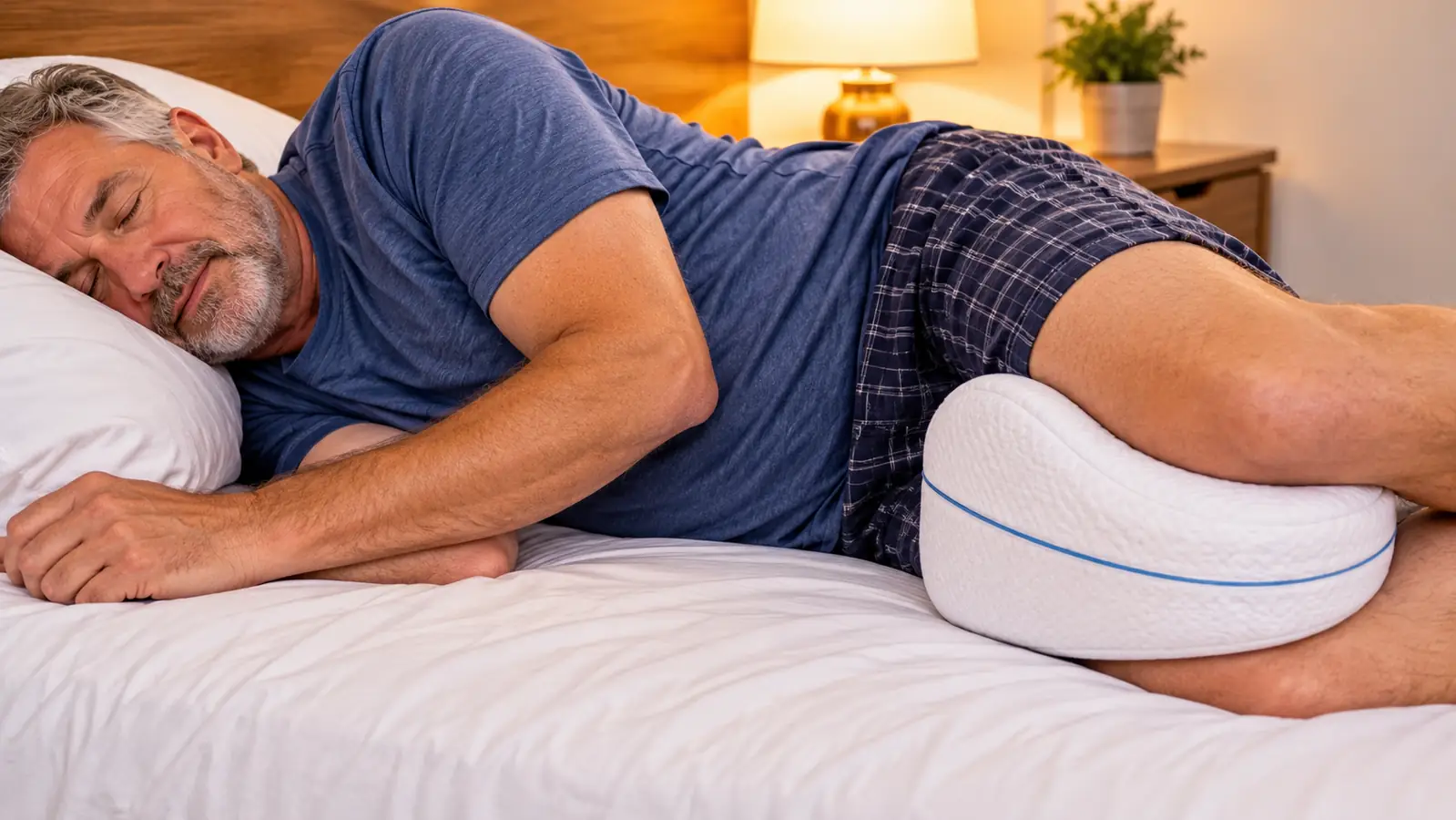
The pillow goes between your knees, not under them. That sounds obvious written down, but I had been doing it wrong for years. I would fold a wool blanket into quarters and wedge it under the bottom knee like a ramp, then wonder why my hip still complained by morning. In February I finally paid attention to what actually hurt and realized it was not the underside of my knee at all. It was the two knees knocking together and my top leg sliding forward. Between the knees is the whole point. It keeps the top leg from drifting and keeps the knees from pressing against each other, which is what was waking me up.
The Contour Legacy is a soft memory foam pillow, about ten inches long and nine and a half inches wide, and it weighs roughly seven ounces, so it does not feel like a piece of furniture in the bed. I put it in place before I turn out the light, lying on my left side first because that is the side I start on. My right knee, the bad one, is the top knee in that position. The pillow sits in the gap, my knees stay apart, and my hips stop twisting forward.
If you sleep on your back most of the night, do not force this. Skip ahead to step four, where I get into back sleeping, because a pillow squeezed between the knees is useless to someone lying flat on their back. There is no prize for using it the way the package suggests.
Step 2: Line It Up So Your Knees and Ankles Both Get Support
Alignment is the part I had to practice. The goal is a straight line from hip to knee to ankle, and the pillow should sit low enough that it supports the length of your lower thigh and the top of your calf, not just the kneecap. My first week I had it pushed too high, almost at my thigh, and my top knee rode up over it. I ended up lying there on a Saturday morning with my glasses on, feeling along the lower edge of the pillow to find where it stopped and comparing that to where my calf began. By the third night I had moved it down a couple of inches and everything settled. Moving it is a two-second job once you know where it belongs.
Before this, I tried three other things and none of them lasted a week. A rolled-up bath towel went flat by three in the morning. A regular bed pillow between my knees was too tall and too soft, and it pushed my top knee up at an angle that made my lower back ache by morning. A foam wedge I ordered from a catalog was the wrong shape entirely and slid out every time I turned over. The Contour is sized for the job, and the listing says it supports both legs and knees, which matches what I feel. The fabric is a polyester and lyocell blend and the foam is described as temperature regulating, pushing heat away from your body. I cannot verify the engineering. I can tell you that I stopped kicking it out of the bed around week two, which is more than I managed with any of the other three.
One adjustment that helped me: bend your top knee slightly, maybe twenty degrees, rather than holding the leg straight. A straight top leg puts a different kind of pull on the hip. Slightly bent, with the pillow filling the space, is the position I come back to without thinking about it now.
Step 3: Give It a Week Before You Decide
The first three nights were not comfortable. I want to be honest about that because too many reviews skip it. The pillow felt foreign, my leg did not know where to put itself, and I woke up twice on the first night and once on the second. That is not the pillow failing. That is a body that has slept the same way for fifteen years being asked to do something slightly different.
By the fifth night I slept through until about five in the morning, which had not happened since the previous spring. That was a Thursday. I remember because the next afternoon I had my youngest grandchild, who is four, and I got down on the living room floor with her to build a block tower without bracing myself on the coffee table first. By the end of the second week I was putting the pillow in place out of habit, the way you reach for a seatbelt. I am not going to tell you the ache disappeared. It did not. My knee still tells me when the weather turns. But the two-in-the-morning waking has mostly stopped, and that alone changed how I feel by lunchtime.
My advice is to change one thing at a time. Do not buy a new mattress, a new pillow and a new set of stretches in the same week, because then you will not know what helped and what you wasted your money on. I did the pillow first, by itself, for two weeks. Gene will tell you I am not usually that disciplined about anything.
By the fifth night I slept through until about five in the morning, which had not happened since the previous spring.

Step 4: Use It for the Positions You Actually Sleep In
Nobody stays in one position all night. I start on my left side, roll to my right around three, and end up on my back for the last hour before the alarm. For the side positions the pillow stays between my knees. When I roll onto my back, I slide it under my knees instead. That small lift takes some of the pull off my lower back and keeps my legs from lying dead flat, which is when my right knee tends to stiffen up.
On the couch in the evening I use it the same way, under my knees while I read in the recliner. It is light enough to carry down the stairs one-handed along with a mug of tea, which matters more at my age than I would like to admit. If you are built like Gene, who is six foot one and sleeps on his stomach, this is not going to be your pillow. He tried it for one night, said it felt like a bar of soap between his legs, and handed it back.
If you share a bed with someone who thrashes, the pillow will end up on the floor some nights. That is not a design flaw. I keep mine on the nightstand when I am not using it, so it is within reach when I roll over at two in the morning and want it back.
Step 5: Keep It Clean, and Stop If It Makes Things Worse
The listing says the pillow is washable, and with something that lives against your skin eight hours a night, that matters. I wash mine every few weeks, usually on a Saturday, and let it air dry on the rack in the laundry room rather than putting it in the dryer. It has held its shape so far, going on several months now. Memory foam can flatten over time, so if yours starts to feel like a folded towel, that is your signal to replace it. Contour includes a one-year manufacturer warranty, which is worth knowing but is not why I bought it.
The more important instruction is the one nobody puts on a label. If you start getting numbness or tingling in your leg, or if your knee or hip hurts more rather than less after a week, stop using it and call your doctor or physical therapist. A pillow is a comfort tool. It is not a treatment, and it is not a substitute for the exercises your therapist gives you. I do mine most mornings, on the floor of the living room, and I complain about them the whole time.
One more thing. Do not stack this on top of six other changes and expect a transformation by Friday. The people who get on well with a knee pillow are the ones who give it a fair trial and adjust the position instead of giving up on night two.
What Else Helps
A pillow is one piece of a larger picture, and I would be lying if I said it was the only thing that mattered. The stretches my physical therapist gave me, done most mornings before I go down for coffee, do more for my daytime stiffness than anything I have bought. Walking most mornings around the neighborhood keeps everything looser than sitting does. And I sleep better in a cool, dark room with the phone charging in the kitchen, which has nothing to do with my knees and everything to do with how I feel at seven in the morning.
If you are a back sleeper, try the pillow under your knees before you decide it is not for you. If you are a stomach sleeper, this is probably not your tool and that is fine. Gene has never once complained about his knees and he sleeps like a starfish. We cannot all be Gene.
Most of all, tell your doctor what you are trying. Mine knows about the pillow, the stretches, and the fact that I am not interested in being talked into anything drastic before I have tried the small things. That conversation is worth more than any review, including mine.
Try One Night and See How You Wake Up
Five steps, one pillow, and a fair two-week trial. The Contour Legacy is what is on my bed in Dayton, and it is the version I would hand to a friend.
Amazon Check Today's Price on Amazon →