

Six years ago a doctor in Dayton looked at an X-ray of my right knee and said the word osteoarthritis the way you would read out a weather report. I was sixty-one then. I am sixty-seven now, retired from the school library, and I still live in the same two-story house with my husband Gene, which means the stairs are not optional. Every morning my knees tell me how the day is going to go before my feet have even hit the floor.
For years I slept with a regular bed pillow wedged between my knees, and it worked about as well as you would expect a pillow built for your head to work between your knees. It slid out around two in the morning. It went flat. I would wake on my back with the right knee aching and my lower back joining in out of sympathy. Then I read about the Contour Legacy Leg and Knee Pillow, bought one with my own money, and slept on it for eleven months before I sat down to write any of this. Nobody sent me one. Nobody paid me.
The Quick Verdict
A soft memory foam leg pillow that keeps both knees supported and stops the top leg from sliding forward. It will not fix your knees. It did make my nights quieter.
Amazon Check Today's Price →The thing I now reach for before I reach for my reading glasses
Soft memory foam, a washable cover, and a shape that holds the space between both knees instead of one. It is the only sleep purchase I have made in five years that I have not regretted.
Amazon Check Today's Price on Amazon →How I've Used It
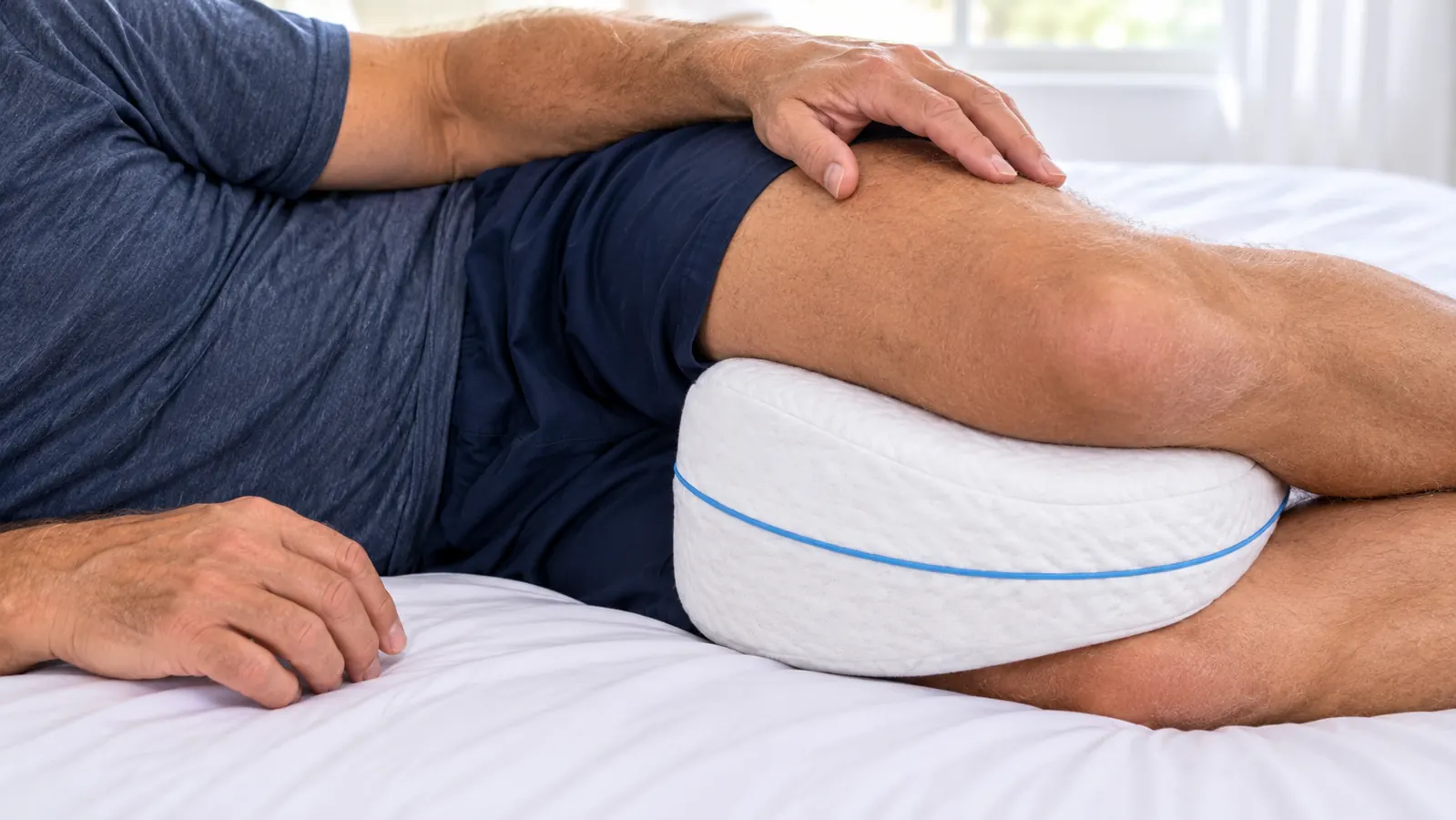
The Contour Legacy lives on my side of the bed, on top of the fitted sheet, and it has not migrated to Gene's side once in eleven months. I am a side sleeper. I start on my left because the right knee is the bad one, and I put the pillow between my knees so the top leg cannot drop forward and drag my hip along with it. That was the whole problem in the first place. My top leg slid forward in the night, my knee came down on the other knee, and my lower back paid the bill by morning.
The pillow is ten inches long and nine and a half inches wide, and it weighs 198 grams, which is about seven ounces. That is light enough that I have never once noticed carrying it from room to room. The design supports both legs rather than just the one resting on top, so my knees stay a comfortable distance apart instead of knocking together and my hips stay square. It sounds like a small thing to describe on paper. It stopped being small around the third week, when I realized I was no longer waking up in the dark to fish a pillow out from under the covers.
I use it downstairs too. After an afternoon in the vegetable garden, I put it under my knees while I read in the recliner, which takes some of the pressure off the back of my legs. And I wash the cover every two weeks. The fabric is 62 percent polyester and 38 percent lyocell, both of which go through the machine on cold without complaint, and I let it air dry on the porch rail. Eleven months in, no pilling, no split seams, no lingering smell.
One thing I did not expect is that it travels well. In June we drove to my daughter's place outside Columbus for four days, and the pillow went into the suitcase without taking up any real room, which a bed pillow never does. I slept fine in a strange bed, and that is unusual for me. At home it lives on my side of the bed and nowhere else, and Gene has learned not to stack his library books on top of it.
What It Actually Is
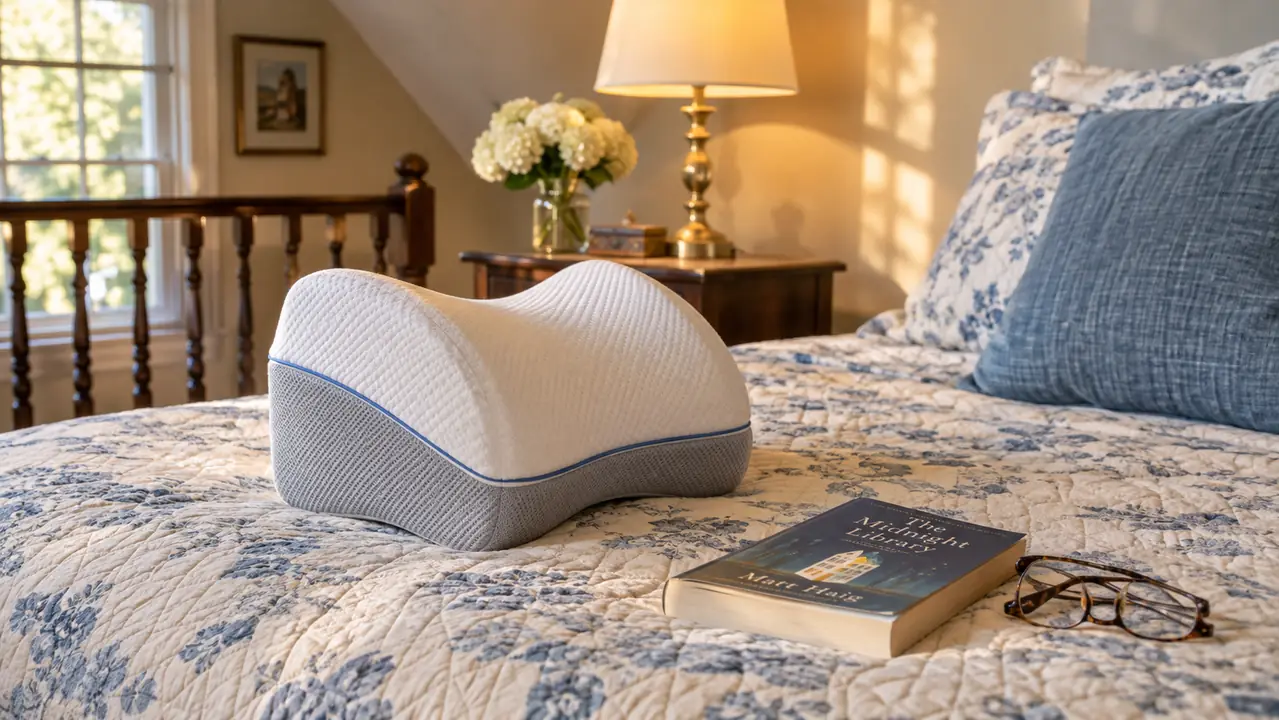
Strip away the packaging and it is a piece of soft memory foam shaped like a leg, wrapped in a washable cover. That is the whole product. Nothing inflates, nothing adjusts, nothing needs assembling, and nothing plugs in. The firmness is on the soft side. If you are expecting something dense and structural, this is not that, and I will come back to that in a minute because it matters.
What the shape does is support both legs at once, and that is the difference that mattered to me. With a bed pillow, only the leg lying on it gets any help. The other leg drifts. The knee drops. The hip twists. The Contour holds the space between your knees so neither knee has to carry the other one all night. Contour has been making this shape since the early nineties, according to the company, which explains why the curve feels less like a novelty item and more like something somebody refined over a long stretch of time.
Before I bought it I tried the free version first, which was a bath towel rolled up tight and held with two rubber bands. It lasted about forty minutes before it unrolled itself into a lump, and it did nothing for the leg on top. I also tried a foam wedge I already owned from a bout of back trouble in 2019. Too tall. It pushed my top knee up above my hip and I could feel it in my lower back by morning. The Contour sits lower than that wedge and about the height of a folded hand towel, which turned out to be the height my hips actually wanted.
The foam is the temperature regulating kind, which pushes heat outward instead of holding it against you. I run warm at night, and I fully expected a foam pillow wedged between my knees to feel like a damp sponge by three in the morning. It does not. The surface stays dry. Whether that is the foam or the fabric I could not tell you, but the effect is real, and it is the main reason I stopped browsing for alternatives.
For scale, a standard bed pillow is roughly twenty by thirty inches. This is ten by nine and a half, so it takes up a fraction of the bed and does not crowd Gene's side or get tangled in the duvet. It comes as a single pillow, which means if you and your husband both want one you are buying two. It also carries a one year customer care warranty from Contour, which I have not had to use, so I cannot tell you how that process goes.
The First Two Weeks
We started on a Tuesday in the second week of March, which I remember because Gene had an appointment that Thursday and I was up earlier than usual both mornings. Night one I put the pillow right up against the knee joint, because that is where it seemed to belong. Night two, same mistake. By night three I was waking with a fussiness behind the right knee and a stiffness in my hip that had not been there the week before. Not pain exactly, more the way a new pair of shoes feels before it stops being a new pair of shoes. I nearly put it in the closet on day four.
The trouble was height. My mattress is medium firm, and with the pillow jammed right up against the knee joint my top knee sat a little higher than my hip was happy about. I fixed it by sliding the pillow down toward my calves instead. That took the pressure off the inside of the knee and let the hip relax. That adjustment is not printed on any instruction sheet. It was just something I worked out over about ten days of paying attention.
By the end of the second week I was falling asleep without thinking about it. That is the test I use for anything new in the bedroom. If I am still arranging a thing at bedtime after fourteen days, it goes in the closet. The Contour passed, and it has passed every night since.
Eleven Months Later: What Changed and What Didn't
I have slept on this pillow for eleven months now, which included a hot Ohio summer and one bitter January, and the foam has held its shape. There is no flat spot where my knee sits. The cover has been through the wash around twenty times and has not shrunk or faded.
The change I can point to is not dramatic, and I am not going to pretend otherwise. My mornings are less stiff than they were. I get out of bed and walk to the bathroom without that first dozen steps feeling like a negotiation. My lower back, which used to complain whenever my knees did, has been quieter. I have no way to prove the pillow is responsible for any of that. I was also doing my physical therapy exercises most days across that same stretch, and my physical therapist would tell you, correctly, that the exercises deserve a good share of the credit.
What I can say with confidence is that I stopped waking up to rearrange things. That is the honest measure. Before the Contour, I was up two or three times a night, hunting around under the covers, half asleep and annoyed. Now I am not. Sleep is not a treatment for arthritis and nobody should sell it as one, but a night that stays unbroken does something for your patience with the rest of the day. Take a Tuesday in late October, the grey kind of Dayton morning where you do not want to get up at all. I was out of bed and downstairs before Gene had the coffee going. I walked to the corner and back without the usual stop at the mailbox to stretch, and I was not thinking about my knees at all, which is the highest praise I can give anything.
The stairs are still stairs. I still take them one at a time going down in the morning with my hand on the rail, and I expect I always will. The pillow did not change my knees. It changed my nights, and my nights were making everything else harder than it needed to be.
Where It Falls Short
It does not follow you. If I roll onto my back in the night, the pillow stays where I left it and I end up with it beside my leg instead of between my knees. I reach for it half asleep and put it back. That is a two second job, but it is still a job, and if you flip from side to side all night long you should expect to do it two or three times before morning.
It is soft, and soft is not for everybody. I am around a hundred and fifty pounds. Gene is closer to two hundred and ten, and when he tried it he said it simply disappeared under him. There is one firmness and no way to firm it up. If you are a larger person or you like a solid, structural feel between your knees, this may be too yielding for you.
And it is a comfort item, not a medical device. It does not strengthen anything. It does not treat anything. It will not stand in for the exercises my physical therapist gave me, and it certainly will not fix a knee that is swollen, locking or giving way. If that is where you are, a pillow between your knees is not the answer. Call your doctor. I say that as a woman who put off calling hers for two years and wishes she had not.
What I Liked
- Supports both knees, so the top leg stops sliding forward and taking the hip with it
- Soft memory foam that has held its shape through eleven months of nightly use
- Cover is 62 percent polyester and 38 percent lyocell, machine washable, and has not pilled
- Temperature regulating foam stays dry through the night for warm sleepers
- At 198 grams it is easy to move from bed to recliner without thinking about it
- Ten by nine and a half inches, so it does not crowd the bed
- One year customer care warranty from Contour
Where It Falls Short
- Nothing holds it against your leg, so you reposition it if you roll onto your back
- One soft firmness only, and heavier sleepers may find it too thin
- It is comfort support, not a fix for an injured or swollen knee
- Sold as a single pillow, so a couple needs to buy two
I stopped waking up two or three times a night to fish a pillow out from under the covers. That is the whole review, really.
Who This Is For
This is for the side sleeper whose knees knock together and whose hips and lower back file the complaint by morning. If you have been folding a bed pillow in half for years and waking up with it on the floor, you are exactly who I had in mind when I wrote this. It also suits back sleepers who want something soft under the knees while they read, and anyone with mild to moderate everyday aching who wants their nights to stop being the hardest part of the day. Check with your doctor or physical therapist before you lean on any pillow as part of a routine, the same way you would before starting a new exercise.
Who Should Skip It
Skip it if you sleep on your stomach, because there is nothing for this pillow to do in that position. Skip it if you need firm, unyielding support, or if you are a large person who will press straight through soft foam. Skip it if you are dealing with an acute injury, swelling, or a knee that locks or gives way, because that is a conversation with a doctor and not a shopping decision. And skip it if you want a product that stays attached to your leg all night without you touching it. This one asks for a small amount of cooperation, and after eleven months I have decided that is a fair price to pay for a night that stays quiet.
Eleven months, one pillow, and no more rearranging at two in the morning
If your knees knock together at night and your back pays for it by breakfast, this is the simplest change I have made to my sleep in years. Ask your physical therapist first if anything is injured. Then give it two weeks before you decide.
Amazon Check Today's Price on Amazon →