

My right knee wakes up before I do. It is a stiffness more than a sharp pain, and it takes about four steps down the hallway before it decides to loosen. I have had that morning routine for six years now, ever since a doctor pointed at an x-ray and said osteoarthritis in the tone people use for a parking ticket.
I tried the usual things first. A heating pad. A brace that made my leg sweat by ten in the morning. A menthol rub that smelled like my grandmother's medicine cabinet and felt good for about twenty minutes. What actually got me back to walking the block most mornings was Voltaren Arthritis Pain Gel, and the honest reason it took a while to work is that I spent the first three weeks putting it on wrong. Not dangerously wrong. Just wastefully wrong.
The gel is the easy part. The application is where people lose the benefit.
Voltaren Arthritis Pain Gel, diclofenac sodium 1 percent, two 100 g tubes with a flip cap you can open one-handed. Read the five steps below before you open the box.
Amazon Check Today's Price on Amazon →Step 1: Read the Tube Before You Touch Your Knee
I am a retired librarian, so you would think reading the label would come naturally to me. It did not. I opened the box, squeezed some gel onto my fingers, and got on with my day. What I skipped was the part about how much to use and how often, which turns out to be the whole difference between a gel that helps and a tube that empties in nine days.
Voltaren is a nonsteroidal anti-inflammatory gel, an NSAID in topical form, and the active ingredient printed on the box is diclofenac sodium 1 percent. That matters for two reasons. First, it is doing something different from a menthol rub, which cools the skin and feels pleasant but is not working on inflammation at all. Second, it means you should tell your doctor and your pharmacist what else you take, including pills, because this is the same family of medicine as a lot of them. I am not a doctor and I do not play one on the internet. Ask yours.
The tube has a flip cap that opens with one hand, which sounds like a small thing until you are halfway up the stairs with a sore knee and nothing to put the cap down on. Read the directions once, standing in good kitchen light with your reading glasses on, and then you never have to think about it again.
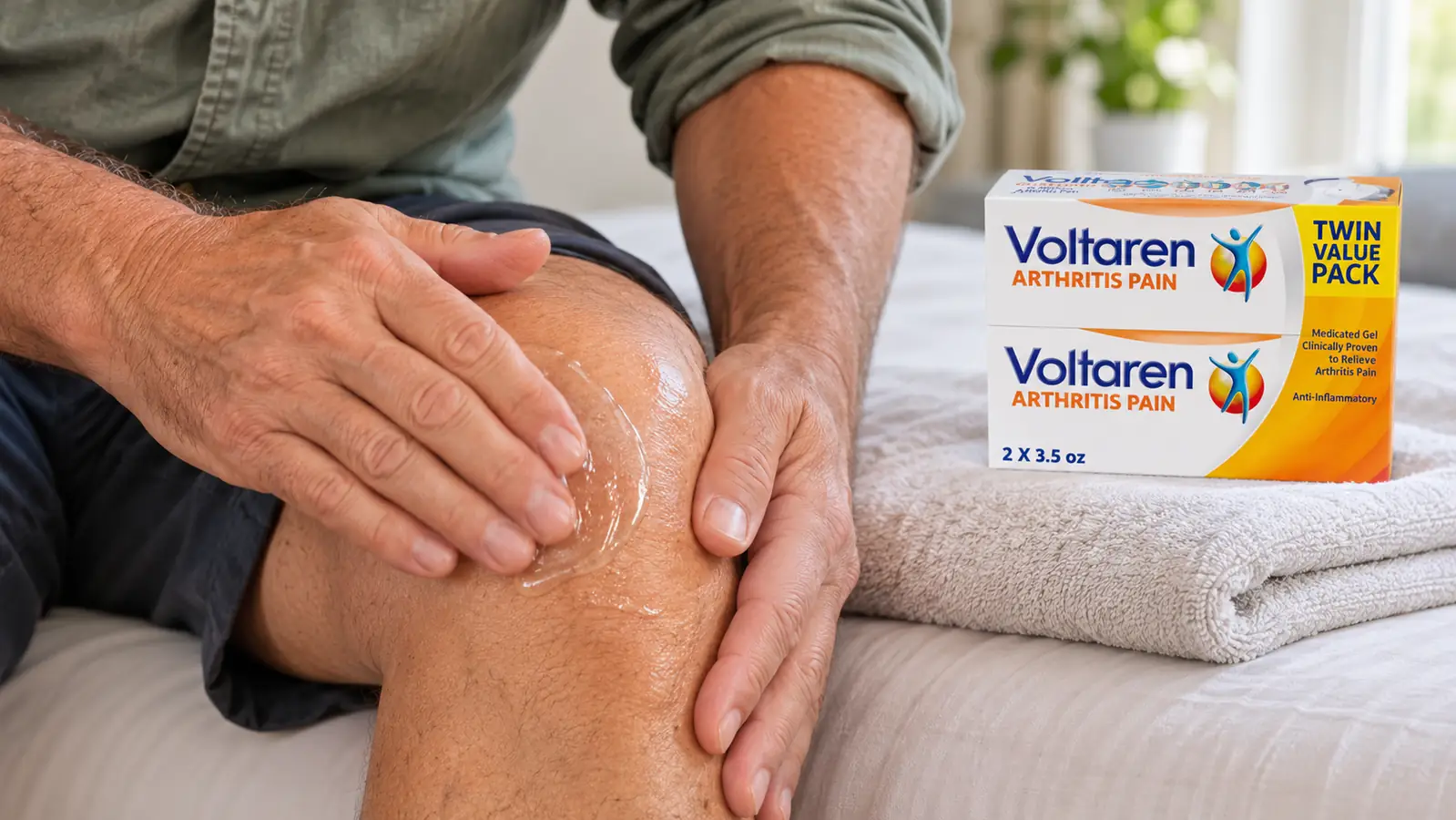
Step 2: Use the Amount the Label Shows, Not a Puddle
My instinct was that more is better. It is not. The label shows how much to use, and the amount surprised me the first time because it looked small for a knee. I followed it anyway, and my second tube lasted a great deal longer than my first.
The trick is to think of it as a measured strip rather than a dollop. Squeeze it out, look at it, and then put it where it goes. If you are prone to eyeballing, measure it the same way twice in a row and your hand will learn what the right amount looks like.
My first tube was gone in nineteen days. I know because I wrote the date on the box flap with a pencil, the way I used to date new books before they went out on the shelf. Nineteen days, using it twice a day exactly as directed, and nothing left for the last morning. The second tube, measured instead of guessed, lasted me five and a half weeks. Same knees, same weather, same everything. The only thing that changed was how much I was squeezing out.
A note for those of us with two bad knees: use the label amount on each knee, not one larger amount spread across both. My left knee is the quieter one and I still treat it as its own separate job. Two knees, two measured applications, and nothing extra squirted on because I am feeling sorry for myself on a Tuesday.
Step 3: Work It In, Do Not Just Smear It On
Here is the mistake I made for three weeks. I rubbed Voltaren on the front of my kneecap, the sorest spot, and stopped there. But a knee that aches on stairs is not only a kneecap. It is the joint line on either side of it, and the soft tissue above and below that gets tight when you have been favoring the leg for months.
What works better is a slow, firm massage in small circles over the whole knee, maybe a minute, until the gel disappears into the skin. My physical therapist showed me this and it made more difference than any other single change I made. Not because rubbing is magic. Because you are covering the joint instead of one sore square inch of it.
The Saturday it clicked for me was the last weekend in September. I had been out back pulling up the tomato cages, which is a job that is mostly squatting down and standing back up, and by mid afternoon my right knee was carrying on. I sat on the edge of the bed, put the gel on, and instead of going straight for the sore spot I started low, below the kneecap, and worked up and around the way my therapist had shown me. Twenty minutes later I got up to start supper and did not do the little rocking motion I usually do first. That was the first time in a month that the gel and I were doing the same job.
Do it sitting down with your leg straight and your heel propped on a footstool. Standing in the bathroom with one hand braced on the sink is how people end up with gel on the bath mat and a sore back to go with the sore knee.
Three weeks of rubbing gel onto the sorest square inch of my knee. It was the joint line two inches to the side that needed it.

Step 4: Wash Your Hands, Then Wait
Wash your hands afterward, with soap, and get under the nails. Then wait. The gel needs a little time to get where it is going, and if you pull a tight brace or a pair of jeans over it immediately, or sit down with a heating pad on top, you are working against yourself. I give it ten or fifteen minutes and use that time for the ankle pumps my therapist gave me.
Ten or fifteen minutes is longer than it sounds. I use it to sit with my leg out and do nothing, which took practice. The first few evenings I got up after three minutes, put my jeans on, and told myself it was close enough. The knee could tell the difference even if I could not, because by eight o'clock the front of my jeans had a grease mark on it and the gel was on the denim instead of on me. Now I keep a library book on the nightstand for those fifteen minutes and the mark is gone.
The other reason to wait is that you do not want this anywhere near your eyes or your mouth. I had one close call after rubbing my brow without thinking, and that was enough for me to build the handwashing into the routine permanently, the way I used to check out library books.
And do not wrap the knee up tight right after. My therapist's rule was loose clothing, nothing compressive, nothing heated, for a good while afterward. Check with yours, because everybody's knees and everybody's medications are a little different, and a rule that suits me may not suit you.
Step 5: Keep an Honest Two-Week Log
The first week I used it, I could not have told you whether it was helping. Knee pain moves around on its own. Weather, sleep, and how much time I spent down on the floor with a four-year-old all change the number from day to day. So I started writing it down.
Nothing elaborate. A line in a notebook each evening: how the morning stiffness felt on a scale of one to ten, whether the stairs felt worse, better, or the same, and whether I had taken anything else that day. Two weeks of that told me more than two months of guessing had.
I used a cheap spiral notebook and a pencil, and I still keep it in the drawer with the seed packets. Looking back at the first two weeks, my morning numbers went from seven to five, which sounds small until you remember that five is the difference between dreading the stairs and taking them. What I did not expect was the note in the margin on day nine: 'stood up off the floor with the four-year-old without using the couch for leverage.' That was the line I cared about most, and it had nothing to do with a pain scale.
It also caught the thing I would have missed. My mornings were not dramatically different. My afternoons were. I could stand up out of the recliner without the little rocking motion I had been doing for a year, and I only noticed because it was written in my own handwriting.
What Else Helps
The gel is one piece of this. It is not the whole thing, and I would be lying to you if I said it was. If you take nothing else from this page, take that.
The exercises matter more than anything that comes out of a tube. My physical therapist gave me four: seated leg extensions, straight-leg raises, a gentle quad set with a rolled towel under the knee, and standing hip abduction while holding the kitchen counter. Ten minutes, most days. I notice when I skip a week, and so does the staircase in my house.
One more change that helped and cost nothing: I stopped carrying the laundry up the stairs in one load. Two smaller baskets, one trip each, hand on the rail. Gene thought I had lost my mind that first week. My right knee thought it was the best idea I had all year. The small changes are dull and they are the ones that hold up, which is not what anybody wants to hear while standing in the drugstore aisle looking at a shelf full of rubs.
Shoes are the boring one nobody wants to hear about. Gene put a new pair of walking shoes in front of me two Christmases ago and my knees quieted down noticeably within a month, because the old soles were worn through on the outside edges. And carrying a few fewer pounds takes load off the joint in a way no gel can. I know. I did not want to hear it either.
The stairs in our house are the real test. Bedroom is upstairs, and it is going to stay upstairs. On bad days I still go up one step at a time with my hand on the rail. That is not failure. That is Tuesday.
A Word About Expectations
I want to be careful here, because I am a retired school librarian and not anybody's doctor. This is a topical anti-inflammatory that is clinically proven to relieve arthritis pain and improve mobility, and that is what the box says. What it is not is a cure, and it does not replace the exercises, the shoes, or the conversation with your physician about the whole picture.
Give it a fair trial before you decide. Two weeks of doing it the way I described is a fair trial. Two days of rubbing it on the sorest spot while standing at the bathroom sink is not, and that is the version most people quit.
If your knee is hot, swollen, locking, or giving way, put the tube down and call your doctor. That is not a gel situation. That is a get-it-looked-at situation, and I say that as someone who ignored a swollen knee for a month because I did not want to be a bother.
Two tubes is enough time to find out if the routine works for your knees
Voltaren Arthritis Pain Gel comes as two 100 g tubes, which is roughly a fair two-week test done the right way. If it helps, you will have the log to prove it. If it does not, you will know that too, and you can tell your doctor something useful instead of guessing.
Amazon Check Today's Price on Amazon →