

My right knee started complaining about six years ago and never really stopped. It is the small things that wear you down: the first four steps of the staircase every morning, the long aisle at the grocery store, getting up off the floor after an afternoon with my four-year-old granddaughter. My doctor calls it mild to moderate osteoarthritis, worse on the right side. I call it the reason I plan my day around where I can sit down. I am 67, I am not interested in being treated like something fragile, and I have tried enough things that did nothing to be a fair judge of the next one.
I read about the TENS 7000 the way I read about everything, which is slowly, with a highlighter and a stack of index cards. A TENS unit sends a gentle electrical current through sticky pads on your skin, and the working idea is that the tingling competes with the ache you already feel, so your mind has something else to pay attention to. My physical therapist put it more plainly than any product page ever could: it does not fix a knee, it may make the day more comfortable. That was enough for me to try one. What follows is how I actually use it, step by step, after six months of keeping it on the side table instead of in a drawer.
The unit I keep on the side table, not in a drawer
The TENS 7000 arrives with the unit, two lead wires, a four-pack of electrode pads and the 9V battery it runs on, so there is nothing else to track down before your first session. Over three million of these have sold, which is either reassuring or a sign that a great many of us have achy knees.
Amazon Check Today's Price on Amazon →Step 1: Get the Go-Ahead Before You Stick Anything Anywhere
The first thing I did was not plug anything in. I carried the box to my physical therapist and asked whether this was a reasonable thing for me to try. She said yes for my situation, and then she said the part I have repeated to two neighbors since: a TENS unit is a comfort tool, not a treatment. It will not rebuild cartilage, it will not straighten anything, and it will not replace the exercises she gave me. If you have a pacemaker or another implanted electrical device, ask your doctor before you even open the box.
I also asked what a session should feel like, because I had no idea. Her answer was a strong, even tingling you could comfortably ignore for twenty minutes. Not a sting, not a burn, not something you grit your teeth through. If it hurts, something is wrong with the pad contact or the setting, and the fix is to stop and start over lower down. That single instruction saved me a week of confusing myself, because the temptation on the first evening is to turn it up until you feel something dramatic and then decide the whole thing is unpleasant.
One more thing before we get into the mechanics. I am not a nurse, a doctor or a physical therapist, and nothing here is medical advice. This is one retired school librarian in Dayton, Ohio telling you what she does on a Tuesday evening. Your knees, your history and your doctor are all different from mine, and the plan should come from them.
Step 2: Set Up the Unit and Prep Your Skin
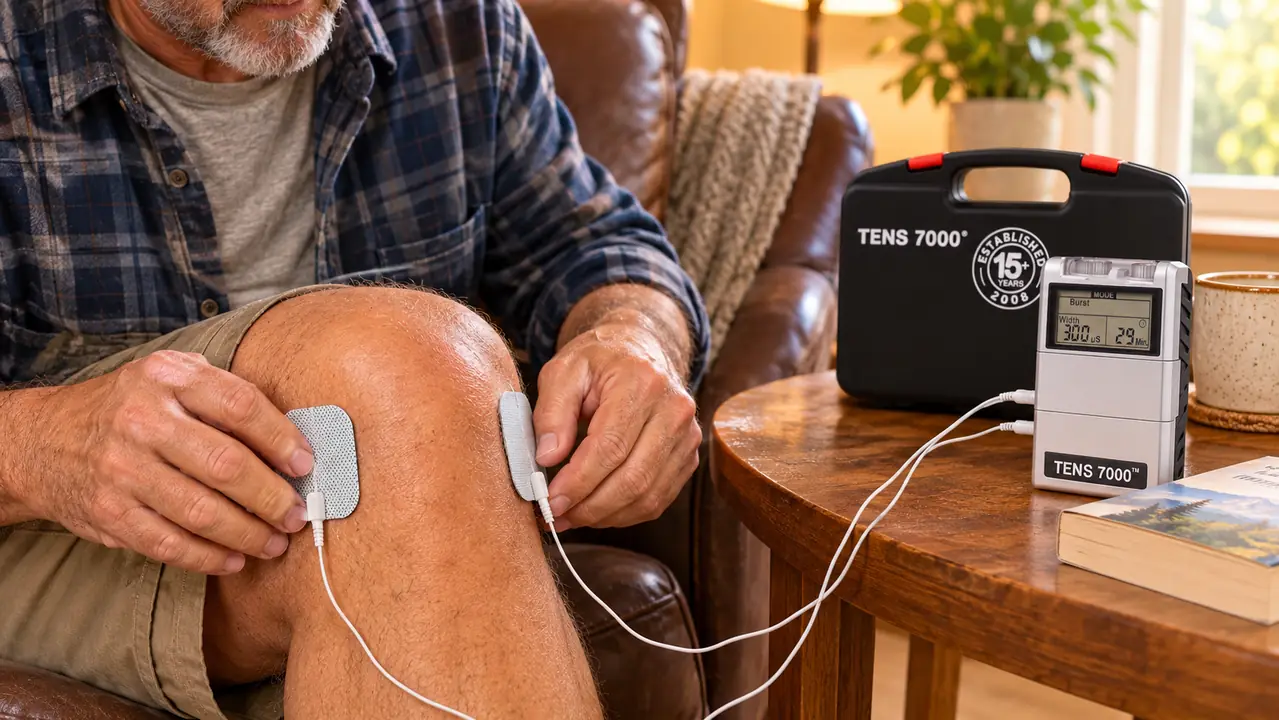
The TENS 7000 arrives with the unit, two lead wires, a four-pack of electrode pads and the battery it needs. It weighs a little over a pound and measures roughly 8.75 by 2 by 7.75 inches, so it sits on an end table without taking over the room. Set it up on a flat surface before anything goes on your skin, because fumbling with wires while half dressed on the edge of the bed is how pads end up face down on the carpet, covered in fuzz, useless.
Skin prep matters more than I expected, and it is the step most people skip. Wash the area with plain soap and water and dry it completely. Skip the lotion that morning, because moisturizer sits between the pad and your skin and the pad will not hold. If you have hair where the pads go, trim it with small scissors rather than shaving, since freshly shaved skin and adhesive do not get along. Then press each pad down firmly for a few seconds and smooth the edges. A pad that is half stuck will sting, and you will blame the machine for something that was really a laundry problem.
The pads are also the part that wears out first, so treat them kindly. When mine stop sticking, I wash them gently with a drop of dish soap and warm water, let them air dry face up, then press them back onto the plastic liner they came on. That buys me several more sessions. Keep the liner, keep the lead wires coiled with the unit, and keep the whole kit in one small tote so you are not hunting for a wire at eight in the evening when you are already tired.
Step 3: Place the Pads Beside the Knee, Not on the Kneecap
Here is where I would have gotten it wrong on my own. My instinct was to put the pads directly on the sore spot, right over the front of the kneecap. My physical therapist corrected that in about four seconds. The pads go to either side of the joint, framing the knee, so the current runs across the area rather than straight through bone. Two above and two below, or two on the inner and outer side, depending on where the ache sits that day.
She walked me through it once with my own unit: one pad on each side of the knee, an inch or so back from the kneecap, on clean dry skin. Never on broken skin, a rash, a cut or a bruise. Never on the numb patch on the outside of my right shin, which I have had since a fall in the 1990s and which she was firm about. The four pads use the two lead wires, and each wire clips onto a pad with a small metal tab. Clip the tab on before you press the pad to your skin, not after, unless you enjoy being startled.
Then I sit down and stay sitting. I do not cook, I do not wander to the mailbox, I do not do chores. Twenty minutes in the recliner with a book is the whole session, and at this stage of life that suits me fine. The first time, I set a kitchen timer because I did not trust myself to notice the clock, and I would suggest the same to anyone starting out.
It does not fix a knee. It makes twenty minutes in the recliner the most comfortable part of my afternoon, and some days that is the difference between a walk and no walk.

Step 4: Start Low, Then Nudge It Up
The unit offers more than one therapy mode, and I will be honest with you, I have settled on one I like and I have not felt the need to be adventurous about it. I start at the lowest setting I can perceive, which is barely a flutter, and I nudge it up over a minute or two until the tingling is noticeable and steady. That is my line. If it becomes something I have to endure, I have gone too far, and turning it back down is not a failure of character.
The sensation itself takes getting used to. My first session felt strange and slightly buzzy, and I spent most of it wondering whether it was doing anything at all. By the fourth session I stopped thinking about it. What I notice now is not a dramatic moment of relief but the absence of something, the way you notice the refrigerator has stopped humming. I get up, walk to the kitchen, and I do not do the two-second pause I used to do before every step.
Two practical notes. If a pad starts to sting while the unit is running, press it back down or stop and replace it. And if your skin looks red or irritated afterward, let that area rest for a day or two and mention it to your doctor at your next visit. Mine gets faintly pink and settles within the hour, but everyone's skin is different and there is no prize for pushing through irritation.
Step 5: Make It a Routine and Keep a Small Log
The thing that made the TENS 7000 useful instead of a gadget in a drawer was tying it to a habit I already had. Mine is the recliner after supper, before I pick up my book. Pads on, twenty minutes, timer on the arm of the chair. I do it most evenings, and I skip it on weeks when my knee is behaving and I would rather just read. That is the entire routine. No ceremony, no chart taped to the refrigerator door.
I also keep a log, and I know how that sounds coming from a retired librarian. It is a spiral notebook with three columns: date, time of day, and one sentence about how the knee felt before and after. Six weeks of that told me something I would never have guessed, which is that it helps me more in the evening than in the morning. Morning stiffness gets my exercises and a hot shower. Evening aching gets the unit.
And I gave it a fair trial before I made up my mind. Four weeks of regular use, then an honest look at the notebook. If it had done nothing, I would have said so right here, packed the tote away and told you to save your money. It is not a cure and it is not a substitute for the work, but it earns its spot beside my chair.
What Else Helps
If you take one thing from this piece, take the part about the unit being one piece of a larger picture. What has helped my knees most, honestly, is the unglamorous work: the home exercises my physical therapist gave me, done most days, including the ones I dislike. A walk in the morning while the sidewalks are quiet. Losing a little weight, which I did slowly and grudgingly and which my knees noticed well before my waistline did.
The small adjustments matter too. A sturdy chair at the bottom of the stairs so I can sit down to put my shoes on instead of balancing on one leg. A heat pack on the back of the knee before I garden, and ice afterward on the days I overdo it, which is most of them. And a rule Gene and I made: if a job needs a ladder, it is his job now. That one took some swallowing. None of this is dramatic and none of it sells anything, but it is the difference between managing a knee and letting a knee manage you.
The unit earns its spot on my side table. So do the exercises, the morning walk, and the rule that anything involving a ladder is Gene's job now.
One more thing before you decide
The TENS 7000 is a comfort tool, and it works best alongside the boring things: your exercises, your walks and whatever your doctor recommends. If that sounds like the right kind of help for your knees, the listing has the full details, the accessories and today's price.
Amazon Check Today's Price on Amazon →