
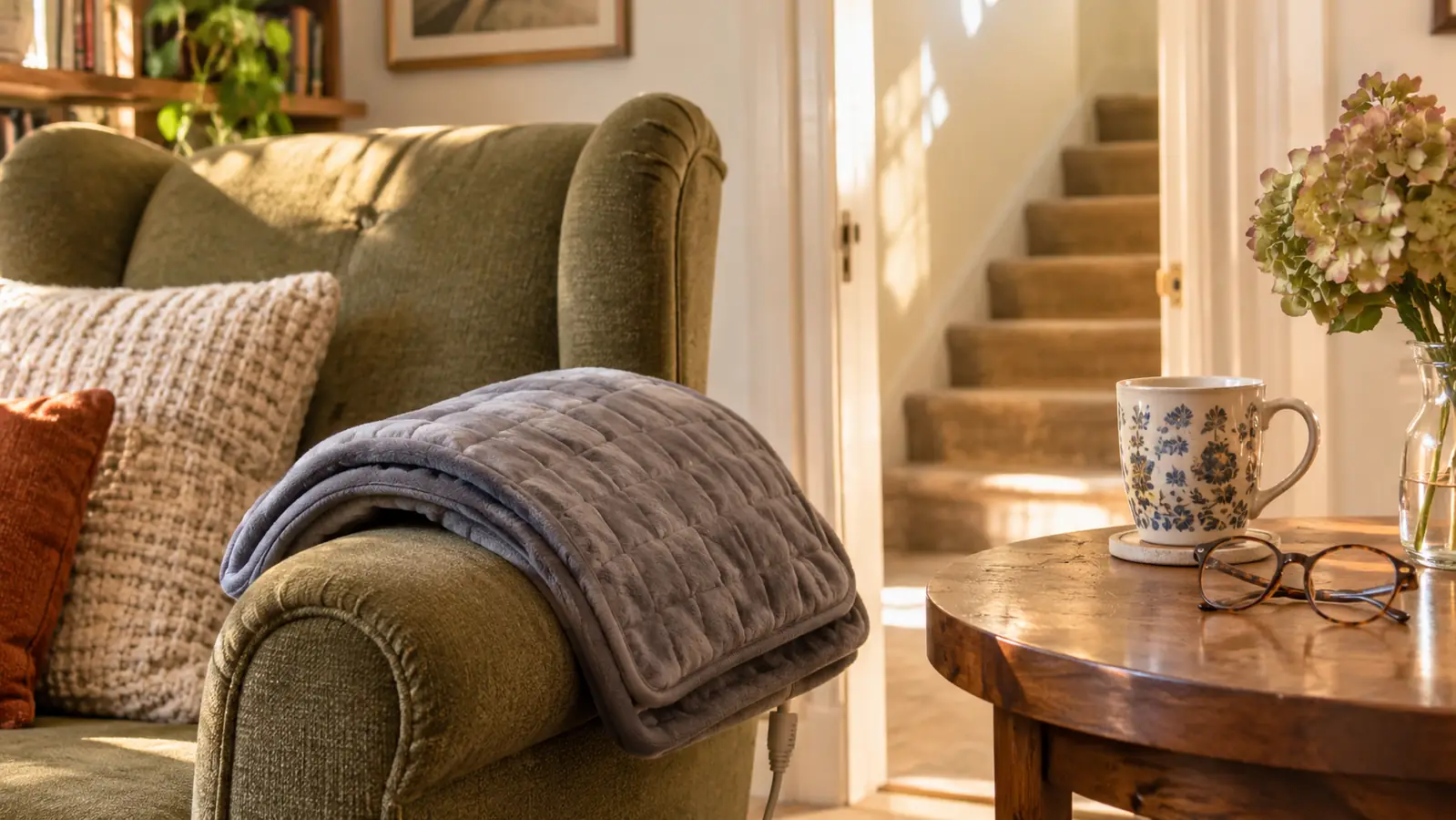
The short answer: these two things do not do the same job, and I would not want to give up either one. But if you are trying to decide which to buy first, a heating pad is the better first purchase and the TENS 7000 is the better second one. The pad is cheap, it is already folded in half the closets in America, and it is what gets my right knee moving in the morning. The TENS 7000 is what lets me keep moving after that, which is the part that used to be missing.
I am 67, I live in a two-story house in Dayton, Ohio with my husband Gene, and my right knee has been the cranky one since about six years ago, when an X-ray gave me the phrase mild to moderate osteoarthritis. The left knee is mostly fine. The right one aches on stairs, aches after my morning walk around the neighborhood, and stiffens up if I sit in the recliner too long with a book. I am not a doctor and I am not going to play one here. What follows is what I noticed in my own house over roughly a year of using both. Anything you decide to try is worth bringing up with your doctor or your physical therapist first. If you have a pacemaker or another implanted device, ask before you use any kind of electrical stimulation, and ask before you fall asleep on a heating pad if your legs have reduced sensation.
| TENS 7000 | Heating pad | |
|---|---|---|
| What it does | Sends a low-level electrical pulse through stick-on pads to change what the knee is reporting | Applies steady warmth to loosen the muscles clenched around the joint |
| While it works | You can be up and moving: dishes, laundry, reading, walking to the kitchen | You sit or lie still against the pad |
| Cord or battery | Runs on one 9V battery, included, so nothing to plug in and no cord across the floor | Needs an outlet, which means a cord trailing where you walk |
| Aiming it | Two lead wires and a four-pack of pads let you place the current where the ache actually is | Warms whatever the pad happens to be touching, one area at a time |
| Setup the first time | Battery in, pads on, wires connected. A few minutes with the instructions open. | Plug it in, switch it on |
| Cost of entry | One purchase, plus replacement pads every so often | Low, and you may already own one |
| First thing in the morning | Not my first pick at six in the morning | The best thing I own for a knee that will not straighten |
| How people get hurt with it | Easy to leave a session running longer than you meant to because it feels good | Easy to doze off on it, which turns warmth into a burn risk |
| Size and weight | 8.75 by 2 by 7.75 inches, 1.15 pounds with the battery in | A flat pad and a cord |
| Best for | Aching that follows you around the house all afternoon | Stiffness that eases with rest and warmth |
Where TENS 7000 Wins
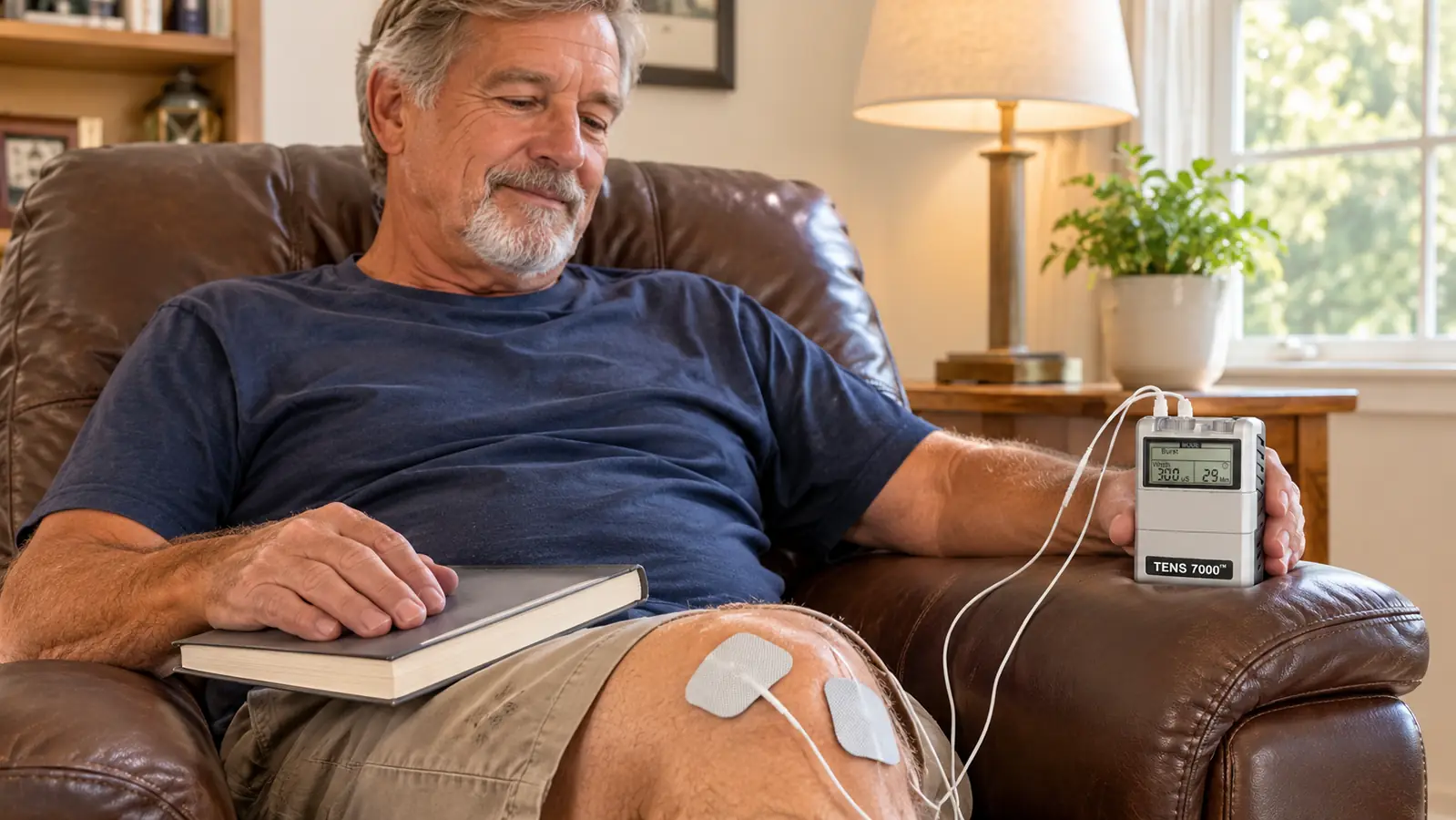
The TENS 7000 wins on one thing above all, and it is the thing that made me keep it past the first week: you are not tied to a chair. The unit runs on a single 9V battery that comes in the box. No cord from the wall to my knee, nothing to step over on the way to the kitchen. It measures 8.75 by 2 by 7.75 inches and weighs 1.15 pounds with the battery in, which puts it in the same weight class as a hardback I would carry out to the porch anyway. I tuck it into the deep pocket of my cardigan, run the lead wires down my leg, and go finish the dishes.
What it does for me is not what an advertisement would have you believe, so let me be plain. It does not make arthritis pack up and leave. My knee still has arthritis and it is going to keep having arthritis. What the pulse does is give the knee something else to report for a while. It feels like a light, even buzz, close to a phone set on vibrate and pressed against the skin. On a bad afternoon I notice the ache settle into the background for an hour or two, long enough to get through the second half of the day. Then it comes back, and I either put the pads on again or I go sit with the pad.
The box comes with two lead wires and a four-pack of electrode pads, which is enough to start without ordering anything else. The unit offers multiple therapy modes, and I will be honest with you: I found two I like and I have not touched the rest in a year. The pads go on either side of my kneecap, or one above and one below when the ache sits lower. Being able to move them around is the whole advantage. A heating pad warms a general area and hopes for the best. The pads let me put the current exactly where the complaint is that day, which for me is usually just below the kneecap on the inside.
The other thing that reassured me was the arithmetic behind it. The listing says more than three million of these have been sold and that it has been a fixture among medical professionals for fifteen-plus years. I cannot verify either number from my recliner, and I am not going to pretend I did. But my physical therapist recognized the brand the moment I brought it in, and that counts for something with a person who reads every label before she buys anything.
Where a Heating Pad Wins
The heating pad wins the morning, and it is not close. My knee after a night in bed feels like it has been packed in sand. Twelve or fifteen minutes of warmth on it while I drink my coffee, and I can stand up straight and get down the stairs like a person instead of like a question mark. That is a specific, repeatable thing, and no electrical device has ever done it for me. Warmth loosens the muscles that have been clenched around a sore joint all night. That is the plainest way I know to say it.
It also wins on being simple. There is nothing to learn. Nothing to stick on the skin, nothing to line up, no battery to think about. You plug it in or switch it on and you sit down. It is the cheaper of the two by a wide margin, and there is a decent chance you already have one folded in a closet behind the extra blankets. For a lot of people that settles the question, and I would not argue with them.
Two cautions, because I would rather be the one who mentions them. A heating pad is a burn risk if you fall asleep on it or leave it on a high setting for a long stretch, and that risk climbs if your legs have reduced sensation from diabetes or nerve damage. My rule is fifteen to twenty minutes, medium at most, and I set a kitchen timer so I do not drift off in the recliner with a book on my chest. The other thing I will say honestly is that warmth helps stiffness and does very little for the ache that shows up at four in the afternoon after two hours on my feet. That gap is exactly where the TENS 7000 comes in.
The pad gets you down the stairs in the morning. This is what gets you back up them at four in the afternoon.
The TENS 7000 runs on one 9V battery that comes in the box, arrives with two lead wires and a four-pack of electrode pads, and drops into a cardigan pocket so you can keep working while it runs. More than three million sold. Ask your doctor or physical therapist before you start, particularly if you have an implanted device.
Amazon Check Today's Price on Amazon →
What a Normal Week Looks Like With Both
Monday through Friday the routine does not change much. I wake up and, before I do anything else, switch the heating pad on and lay it over the right knee while the coffee brews. Fifteen minutes of that, then the exercises my physical therapist gave me on the living room floor, which I do most days and skip more often than I admit. By mid-morning I am fine, and I would not have bet on that six years ago.
The TENS 7000 comes out on the afternoons I am on my feet. Two afternoons a week I have grandchildren, and the youngest is four, which means a great deal of getting down on the floor and back up again. I put the pads on before they arrive. I stop noticing the buzz after the first ten minutes; what I notice is that I am not thinking about my knee while I am building a tower out of blocks. Later, when they have gone home and I finally sit down, that is when I am glad I thought ahead.
There is one more test I use and it is not medical. My vegetable garden is out back and the ground is uneven. Two summers ago I did the planting in stages, sitting on an overturned bucket between rows, and paid for it that night. This past summer I put the pads on before I went out and finished the tomatoes in one go. I was tired afterward, which is normal at 67. The knee was not the reason I stopped, and that is a different sentence than the one I would have written two years ago.
Evenings are the pad again, in the recliner, with a book. Twenty minutes and then off, because I know myself and I will fall asleep. The TENS 7000 lives in the basket beside the chair with the pads and a spare battery, because if it lived in a drawer I would not use it. That is the least technical advice in this whole piece and probably the most useful.
Twelve minutes of warmth gets me down the stairs in the morning. The TENS 7000 gets me back up them at four in the afternoon, and that is the hour that used to be missing.
Who Should Buy Which
Buy the heating pad first if your knee is stiff in the morning or after sitting, if money is tight, or if you are not sure you want a device with pads and wires. It is cheap, it is simple, and roughly half of you already own one. It is also the better first choice if you have an implanted device, because warmth carries none of the cautions that electrical stimulation does.
Buy the TENS 7000 first if the ache bothers you more than the stiffness does. If you get out of bed fine but find yourself favoring that knee by mid-afternoon, if you are on your feet for grandchildren or a garden and want something that comes with you instead of something you have to lie down under, the TENS 7000 is the one doing that work. It is also worth asking your physical therapist about, because mine had opinions and they were good ones.
If you can manage both, my honest answer after a year is that both is the answer. They cover different hours of the day and neither one is a cure. Neither of them will talk you out of the exercises your physical therapist gave you, and neither one replaces a conversation with your doctor about what is actually going on in that joint. But between the two of them I climb my own stairs, walk my own neighborhood, and get down on the floor with a four-year-old, and a couple of years ago I had started arranging my whole day to avoid all three.
The hours between three and five in the afternoon are the ones worth buying this for.
One 9V battery, included. Two lead wires and a four-pack of electrode pads in the box. Wear it in a cardigan pocket while you finish what you were already doing. Check with your doctor or physical therapist before you start, particularly if you have a pacemaker or another implanted device.
Amazon Check Today's Price on Amazon →