

Nobody warns you that the hardest part of buying a TENS unit is figuring out whether the buzzing is doing anything, or whether you have simply found an expensive way to feel something. I am 67, I have osteoarthritis in both knees with the right one clearly worse, and I bought the TENS 7000 Digital TENS Unit four months ago after my physical therapist said it was worth trying and then moved on to the next item on her list. Since then I have used it in the recliner, at the kitchen table, on the sofa with my feet up, and once in a church parking lot before a granddaughter's birthday party. This is not a story about how a machine fixed my knees. It is a plain account of what the thing does, what it does not do, and the parts of owning one that the product page leaves out.
The short version, for anyone who wants it before the long one: it helps, in a limited way, for an hour or two at a time, and it is no substitute for the exercises my therapist gave me or for the walk I take most mornings. The TENS 7000 is well made, simple enough that I figured it out without reading the manual twice, and it has become part of my evening rather than the center of my day. If you are hoping for a machine that lets you skip the stairs and take up running again, this is not it. If you want something to take the sharp edge off a bad evening so you can sit through the news without shifting your leg every two minutes, that is much closer to what this is.
The Quick Verdict
A sturdy, uncomplicated unit that quiets an aching knee for an hour or two in the evening. Expect to keep buying pads, expect to need a therapist to show you where they go, and do not expect it to replace your exercises.
Amazon Check Today's Price →The Machine That Lives on My End Table
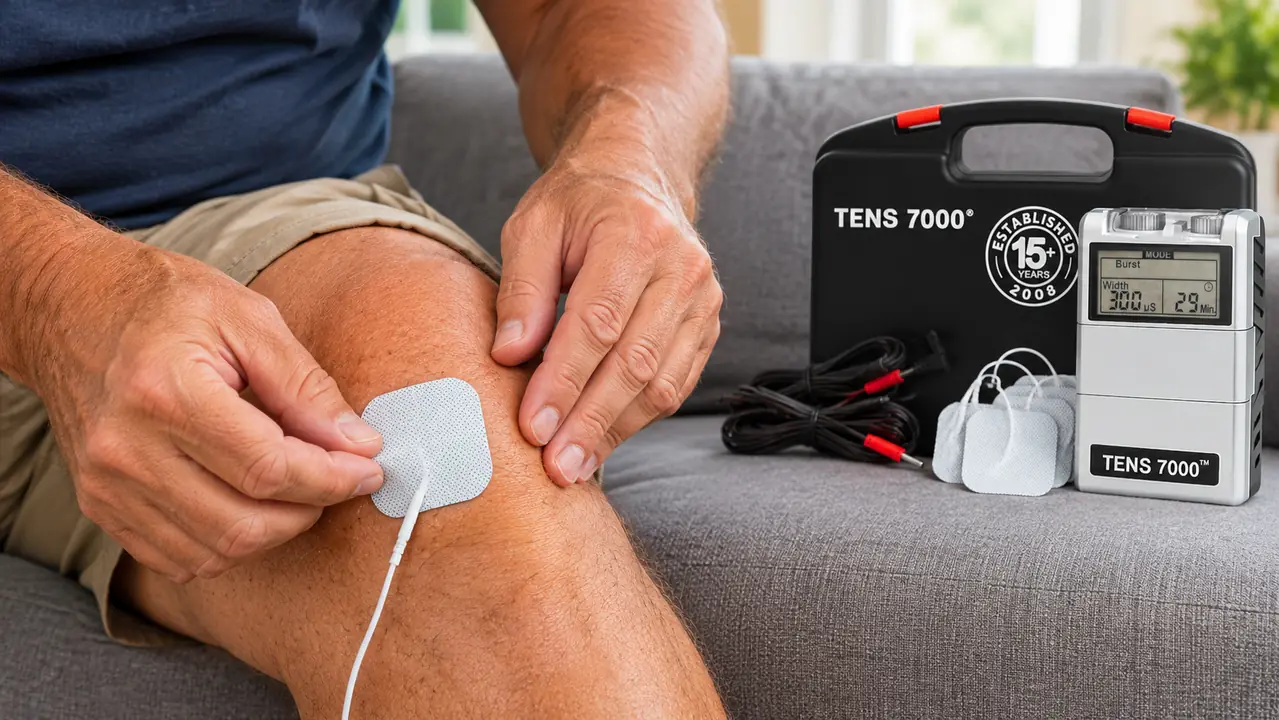
One 9-volt battery, two lead wires and a four-pack of pads in the box. It will not fix your knee. It will make an hour of it easier.
Amazon Check Today's Price on Amazon →The First Thing Nobody Tells You
The pads are the product. I did not understand this when the box arrived, and I would have bought differently if I had. The unit itself sits quietly and does its job without complaint. The pads are what decide whether you use the thing on a Tuesday evening or leave it in a drawer until spring. They stick firmly for a while. Then they stick less. Then one corner lifts, the current begins to prickle under that corner, and you find yourself pressing the pad down with your thumb while trying to read a paragraph for the third time.
This is not a manufacturing flaw. It is how sticky pads behave, and anyone who has used one of these machines for more than a few months knows it. The practical consequence is that you should think of the pads as something you keep buying, the way you keep buying coffee filters. The box includes a four-pack of them and two lead wires to get you started. It will not last you forever, and a fair number of the complaints you read about machines like this are really complaints about pads.
The other thing nobody mentions is placement. Two lead wires and a sheet of backing paper do not tell you where the pads belong. I asked my physical therapist to show me, and she put one on either side of my right knee, one a little above the joint and one a little below, and told me to keep them away from any cut or scrape. If you have a therapist, ask her to mark the spots. If you do not, ask your doctor before you start guessing. A device that sends a current into your leg is not the place for improvisation.
Why I Picked This One
There are dozens of these machines for sale and most of them look identical in the photographs. I picked the TENS 7000 for three reasons that had nothing to do with the marketing language. It has been sold for a long time. It had more than a hundred thousand ratings at an average of 4.6 stars when I looked, which tells you something about how many of them are sitting in how many living rooms. And the accessories came in the box, so I did not have to guess what else to order. I am a retired school librarian, not a biomedical engineer. I picked the one that had clearly already been in a great many homes.
What I can tell you is that a device like this lives or dies on boring questions. Does it turn on when you want it to? Does the battery sit in its compartment without rattling? Do the lead wires stay in their sockets when you shift in the chair? Four months in, mine answers yes to all three. I have knocked it onto a hardwood floor once, by reaching for a book and catching the wire, and it survived with nothing worse than a scrape on the corner. That is not a laboratory test, but it is the test most of these machines actually face.
One more practical note: it is not discreet. Mine lives on the end table with the wires trailing off it, and if someone comes to the door while it is running, you have about four seconds to decide whether to answer it or pretend you are not home. My husband Gene finds this funnier than I do. Most evenings I use it after the neighbors have gone to bed, which suits me fine.
How I've Used It
My routine is unglamorous. After supper I sit in the recliner, put the pads where my therapist showed me, and read for a chapter or two. When the chapter ends, the pads come off, the wires get looped back over the machine, and I go on with my evening. The whole business takes about as long as it takes to get comfortable, which is rather the point. It is not a treatment session. It is a way to get through an hour without thinking about my knee.
The evenings that made me keep it are the ones that follow a long day. Two afternoons a week I watch my youngest grandchild, who is four, which means a great deal of getting down onto the floor and back up again. By seven o'clock on those days my right knee is telling me about it in no uncertain terms. Twenty minutes in the recliner with the unit running and the ache moves from the front of my mind to the back of it. It does not leave. It stops being the loudest thing in the room.
I want to be clear about the mornings, because this is where people misunderstand what they are buying. In the morning my knee is stiff, and a machine that buzzes is the last thing I want on it. That is a heating pad morning, and a hot shower, and the stretches my therapist gave me before I have even had breakfast. The unit earns its place in the evening, when the ache is tired rather than stiff. If you expect it to take the place of heat, you will be disappointed. They do different jobs and you will probably end up wanting both.
The worst stretch was in March, when the weather turned cold and damp and my knee complained from the moment I got out of bed. On the worst of those nights I used the unit twice, once after supper and once before bed. I will not pretend it rescued a bad week. It took the edge off for a while and the edge came back. That is the bargain you are making with a device like this, and I would rather tell you straight than hand you a story about how my life was transformed.
It does not leave. It stops being the loudest thing in the room.
What It Feels Like, and Why the First Week Is Mostly Guessing
The sensation is odd and takes getting used to. It is a fast, fine buzz, a little like a phone vibrating through a cushion, and you notice it before you notice anything else. The trick, for me, was bringing it up until I could feel it clearly and then easing back a notch. Too little and you will decide the machine is useless. Too much and you will flinch, switch it off, and not come back to it for a week. I managed both in my first seven days, so do not feel badly if you do the same.
The unit offers multiple therapy modes. I tried several during the first week and then found one I liked and stopped experimenting. That is not a criticism of the machine. It is a description of me. Unless your therapist tells you to work through the modes in a particular order, there is no prize for using all of them, and the settings you never touch will not make your knee any better.
What it does not feel like is warmth. People hear the word therapy and picture heat. This is not heat. There is no glow, no loosening of a tight muscle the way a hot bath gives you. What there is, in my case, is a drop in the volume of the ache for a while after the pads come off. An hour, maybe two on a good night. I kept a small notebook through the first month because I wanted to know whether I was imagining the improvement, and the notebook says the same thing almost every week.
Where It Falls Short
The complaints are real and they are mostly about friction. There are wires. They run from the machine to the pads and they catch on the arm of the recliner, on the blanket over my knees, and on the cord of the lamp beside me. You have to sit reasonably still. You cannot wander out to the kitchen to check the oven with the thing running unless you want to find out what happens when a lead wire goes taut.
The machine is small enough for an end table and not small enough for a pocket. The box it arrives in measures 8.75 by 2 by 7.75 inches and the listing puts the weight at 1.15 pounds. It runs on one 9-volt battery, which is included in the box, and 9-volt batteries are easy to find at any hardware store, which matters more than it sounds when you are settled in and the buzz begins to fade.
There is also a small social awkwardness I did not anticipate. When the grandchildren visit, they want to know what the wires are. The youngest, who is four, wanted to hold one, and I had to explain that it is not a toy and no thank you, we do not pull on that. You end up explaining the machine to people, usually while it is running and you cannot get up to demonstrate anything.
What I Liked
- Simple enough to run without studying the manual
- Quiets an aching knee for an hour or two in the evening
- Runs on one 9-volt battery that comes in the box and is easy to replace
- Small footprint, and the pads and lead wires are included to start
Where It Falls Short
- The pads wear out and you will keep buying them
- Wires mean sitting still, which is not always what a bad knee wants
- No guidance on where the pads go, so you need a therapist or doctor
- Does nothing for morning stiffness, which is a job for heat

What It Does Not Do
It does not strengthen anything. This is the part I want to be blunt about, because it is the part that gets lost in all the talk. The unit quiets a signal for a while. It does not build the muscle around the knee, it does not improve your balance, and it does not make the stairs easier next month. The things that did that for me were the home exercises I do most mornings and the walk around the block, both of which are dull and neither of which arrives in a box.
It also does not tell you whether it is working. There is no reading, no score, no progress. You decide for yourself whether this evening was better than the last one, and you will second-guess yourself for the first few weeks. That ambiguity is normal with this kind of device. It is also why I suggest keeping notes for a month, so you have something sturdier than your memory to argue with.
And it does not travel well. I took it to my daughter's house for a long weekend and used it once, on a chair in her living room with the wires draped over the arm, and the whole thing felt like a production. At home it takes ten seconds to set up because everything has a place. Away from home it takes ten minutes and a conversation.
Who This Is For
This suits someone who has already been told what is wrong with the knee and has a therapist or a doctor who will show them where the pads go. It suits a person who can sit for twenty minutes in the evening and who wants something between a heating pad and a stronger medication. It suits people who do not mind a bit of fiddling and who accept that pads are a recurring purchase, like furnace filters. If you are the sort who reads the manual before turning anything on, the TENS 7000 will not insult you.
Who Should Skip It
Skip it if you want something you can wear while cooking, gardening or walking the dog. Skip it if nobody has evaluated your knee and you are hoping a machine will diagnose you. Skip it if you have a heart condition, a pacemaker or any implanted device, or if you are pregnant, without asking your doctor first, because that is not a decision to make off a product page. And skip it if you need relief that lasts all day. Nothing about this lasts all day.
Before You Turn It On
Talk to your doctor or physical therapist first, and ask specifically where the pads should sit on your knee and how long you should leave it running. Ask whether they belong above the joint, below it, or on both sides. Ask what to do about skin that turns pink. Write the answers down, because you will have forgotten them by the second week. Then keep it simple. One setting, one chair, one chapter of a book, and a notebook to record whether the evening was better than the last one.
It Will Not Fix Your Knee. It Will Make an Hour of It Easier.
The TENS 7000 comes with two lead wires and a four-pack of pads, and it runs on a single 9-volt battery that is already in the box. The rest is a comfortable chair and a therapist who will tell you where to put the pads.
Amazon Check Today's Price on Amazon →