

Thirteen. That is how many steps run from my front hall up to the landing, and for two years I knew the number because I counted every one of them. My right knee would stiffen somewhere around step four, and by step nine I was pulling myself up with the banister instead of pushing with my leg. I am 67, I have osteoarthritis in both knees and the right one is worse, and I was not ready to move my bedroom to the first floor. So I started paying attention to two things: how I climbed, and what I put on my knee before I did it.
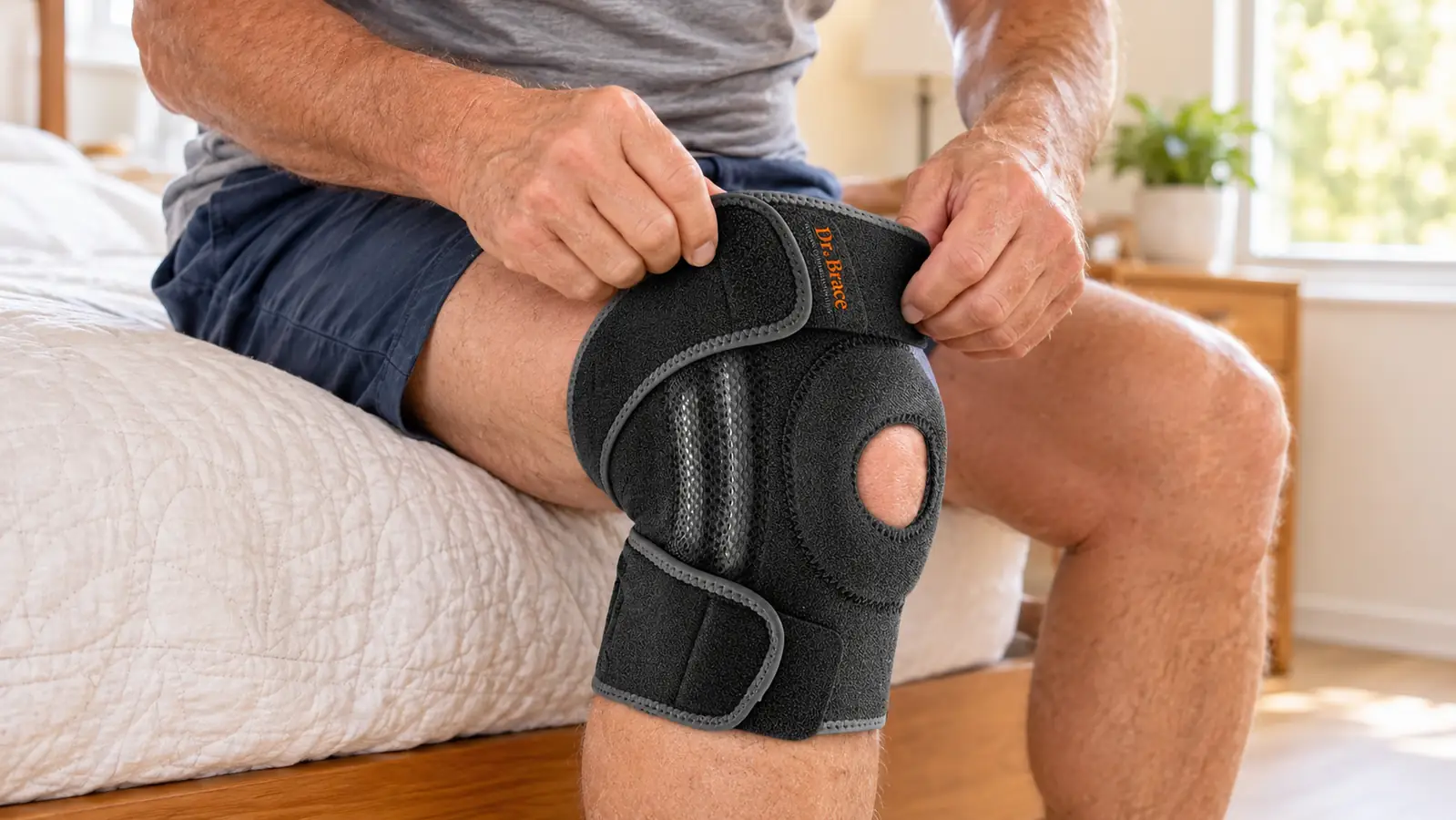
The second part is where the DR. BRACE Elite came in. My first attempt was a drugstore compression sleeve, the kind you roll on like a sock. It felt like support for about twenty minutes, and then it slid down behind my knee and bunched up. The Elite is built differently. It has side stabilizers that run along both sides of the joint, a patella gel pad that sits over the kneecap, adjustable straps, and non-slip silicone strips that hold it where you put it. It does not fix a knee. Nothing I have bought fixes a knee. What it does is make the stairs feel less like a negotiation.
What I strap on before the stairs, not after
The DR. BRACE Elite has the side stabilizers, patella gel pad and adjustable straps I wanted, in a brace I can put on by myself in the morning. Today's price and the current sizing are on the listing.
Amazon Check Today's Price on Amazon →Step 1: Get the knee calm before you load it
The worst stair climb of my day is the one right after I get out of bed. That is not a bracing problem, it is a stiffness problem, and strapping a brace over a knee that is already cranky does not help. My physical therapist put it to me this way: you would not put a shoe over a swollen ankle and go for a walk. Same idea, and it took me an embarrassing length of time to accept it.
So my first step happens before the brace comes out of the drawer. I sit on the edge of the bed and pump my ankle twenty times, then straighten and bend the knee slowly while I am still sitting down. Five or six of those and the joint stops feeling like a hinge that has rusted shut. Then I stand, put my weight on both feet, and take a few steps around the bedroom before I go anywhere near the staircase.
If the knee is puffy on a given morning, I do less. I take the stairs once, slowly, and I skip the up and down trips with the laundry that day. This is the part where I am supposed to tell you to check with your doctor, and I mean it, because swelling that shows up out of nowhere is a conversation for a professional, not for a retired librarian with a laptop.
I also keep a small notebook in the kitchen drawer and write down the days the stairs are bad, not the days they are good. After a few months I could see a pattern: the bad days followed the afternoons I spent two hours weeding the garden, or the mornings after I slept badly. Knowing that did not stop the bad days, but it stopped me from being surprised by them, and it stopped me blaming the brace for something the brace was never going to fix.
Step 2: Fit the DR. BRACE Elite so the stabilizers sit beside the joint
A brace in the wrong place is worse than no brace, because it makes you trust something that is not doing anything. The first time I put the Elite on I had it too low. The patella gel pad was sitting under my kneecap instead of over it, and the side stabilizers were on the meat of my calf. I climbed the stairs, felt nothing useful, and decided I had wasted my money. Then I read the little manual that came in the box and realized the mistake was mine.
Here is how I do it now. I sit down and bend the knee to about a right angle. I center the gel pad directly over the kneecap, which for me means I can feel the silicone settle into the hollow around it. Then I check that the two side stabilizers run along the inside and outside of the joint and are not twisted forward. Only then do I tighten the adjustable straps, starting from the bottom one and working up, snug but not tight enough to leave a mark.
The non-slip silicone strips are what keep it from creeping down my leg over the course of an afternoon, which was the failure of every sleeve I tried before this. The fabric is lightweight and breathable, which matters more than I expected, because a brace you sweat in is a brace you stop wearing. Two honest notes: the materials include neoprene, so it runs warm in July, and on a very long day I can feel the straps. Neither one has made me stop using it.
Step 3: Rehearse on flat ground and one step before you take the whole flight
Do not test a new brace on the full staircase. I did that once with a different brace, it slid down my leg halfway up, and I had to hold the railing and shuffle back down feeling foolish. Now I break it in on the level first.
I walk from the kitchen to the front hall and back maybe three times. I am checking two things: does the brace stay where I put it, and does my knee feel held rather than squeezed. Then I do one single step, up and down, with my hand on the rail. If that feels steady, I do three steps. If three feels steady, I do the flight.
This sounds fussy. It takes about four minutes. But it has saved me from the specific misery of being halfway up a staircase with a brace that has rotated and a knee that has decided it is finished for the day.
The one step test is also how I decide whether to wear the brace at all on a given morning. Some mornings the knee is quiet, I climb without it, and everything is fine. Other mornings it is not, and I want the support before I start rather than after I have already made things worse. Having a four minute way to find out which kind of morning it is has been more useful to me than any rule I have read online.
Step 4: Change the way you go up and down
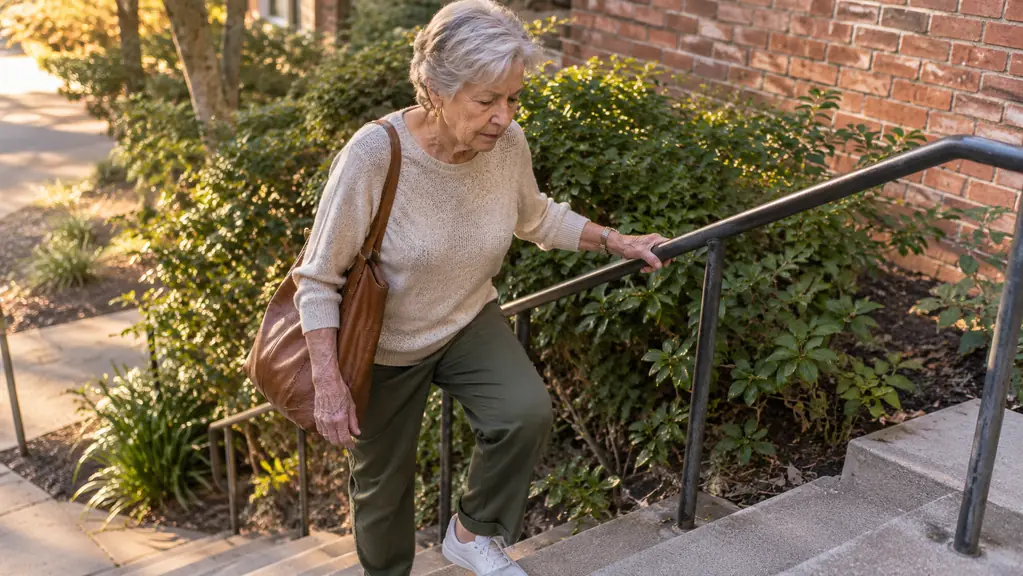
The brace helps, but the pattern helps more, and this was the single biggest change I made. Going up, the good leg goes first. My left knee is the better one, so left foot onto the step, then the right foot joins it. Going down, the reverse: the braced, worse knee leads and the good leg follows. Up with the good one, down with the bad one. It feels unnatural for about a week and then it becomes the way you climb without thinking.
Descending was the part I had backwards for years. Going down loads the knee differently than going up, and I used to take the stairs fast on the way down because it felt easier. It is easier, right up until it is not. Slower on the way down, one foot per step, is the habit that stuck.
The other half of it is the railing. I spent years treating the banister as decoration. Now my right hand is on it every single trip. There is no award for climbing stairs hands free at 67, and the day I stopped gripping the wall on my way past instead of the rail was the day the stairs stopped feeling like a risk.
I also stopped carrying a laundry basket up in both arms. One arm holds the basket, one hand holds the rail, and if the basket will not fit in one arm it waits at the bottom until Gene comes in. This is not a surrender. It is a trade I made willingly for a knee that does not ache for two hours afterward.
Step 5: Rebuild the muscles that are supposed to do the work
A brace is a helper, and helpers are supposed to work themselves out of a job. The muscles around my knee, particularly the ones on the front of my thigh, had gotten lazy over two years of letting the banister do the lifting. My physical therapist gave me a short list of exercises and told me the brace would buy me time while those muscles came back.
The Elite comes with a weekly exercise program for stronger knees and a rubber band in the box, which I did not expect. I use the band for the seated leg extensions and the side steps she assigned me. I do them four mornings a week, ten minutes, on the days I am not walking the neighborhood. Nothing dramatic. The point is not to be impressive, it is to be slightly less weak next month than this month.
I am not telling you which exercises to do. I am telling you that the brace did more for me once I paired it with the boring work than it did on its own. Ask your physical therapist for the list that fits your knee, and if you do not have one, ask your doctor for a referral. Six visits stretched over a year changed my mornings more than any product has.
Progress here is slow and mostly invisible, which is why I like having the brace as a marker. Six months ago I could not come down the stairs without both hands on the rail when the knee was bad. Last week I came down carrying a mug of tea in my left hand and holding the rail with my right, and I did not think about it until I was already in the kitchen. That is the kind of improvement nobody photographs. It is also the kind that actually changes your day.
What Else Helps
A few small things made a difference alongside the brace. I put a nightlight at the top of the stairs, because half my trips are at 2 a.m. and turning on the overhead light wakes me up properly. I keep a pair of supportive shoes by the front door, since padding around in slippers on a hard hall floor was doing my knees no favors. And I moved the things I use every day, the reading glasses, the phone charger, the tea, to the floor I am actually on, instead of making the stairs a delivery service.
The other thing I would tell anyone is to be patient with the fitting. My first week with the DR. BRACE Elite was not a revelation. The second week was better, once the pad and the straps were in the right spots, and by the third week I was putting it on without thinking about it, which is the real test of whether a piece of equipment is going to stay in your life or end up in a drawer.
One last thing, and it is the least satisfying advice I have. The stairs got easier over months, not days. I bought the brace in a January, and the difference in how I took that flight was clear by March. If you are looking for the morning after, no brace on a listing page is going to give you that, and the ones that claim it are the ones I would trust least.
The brace does not fix a knee. What it does is make thirteen steps feel like thirteen steps again.
If the stairs have become the part of your day you plan around
Check the current price, the sizing and the return window on the DR. BRACE Elite listing before you order, and give yourself a full week to get the fit right.
Amazon Check Today's Price on Amazon →