

I bought the DR. BRACE Elite Knee Brace in March, four days after I got stuck on my own kitchen floor. Nothing dramatic happened. I had knelt down to pick up a crayon for my four-year-old granddaughter and my right knee simply would not straighten again. Gene found me sitting there with my back against the cabinet. By then I had already tried a drugstore compression sleeve that rolled down my leg every twenty minutes, and a hinged brace so bulky I could not wear it under my good slacks. So I ordered this one, and I have worn it most days since.
Here is the part the listing does not tell you. The DR. BRACE Elite is not a new knee. It is a well-made piece of fabric with two spring strips down the sides and a gel pad around the kneecap, and it does three things well and several things not at all. I have worn it through a full gardening season, two afternoons a week of babysitting, and a family trip that involved more stairs than I care to count. This is what I actually found, including the parts that annoyed me.
The Quick Verdict
A genuinely supportive brace for achy, arthritic knees and long days on your feet. It will not fix anything, it takes two hands and some patience to put on, and it is too warm for July. I have kept walking, and that is the whole point.
Amazon Check Today's Price →The brace I reach for before I go downstairs
Adjustable straps, side stabilizers and a gel pad at the kneecap, all in a soft brace you can wear under slacks. Check today's price on Amazon.
Amazon Check Today's Price on Amazon →How I've Used It
Let me be specific, because supportive means nothing on its own. My right knee has mild to moderate osteoarthritis, diagnosed about six years ago. The left one is not bad. Mornings are the worst time, that first walk down the stairs when everything is stiff and I go one step at a time with my hand on the rail. I started wearing the brace for that descent. Then for the two afternoons a week I babysit, which involves a great deal of getting down on the floor and back up again. Then I started wearing it for my morning walk around the neighborhood, and that is where I noticed the most difference.
Let me also tell you what I tried before this, because it explains why I am so precise about what the brace does and does not do. First was a plain elastic sleeve from the pharmacy, the kind that comes in a box sized small through extra large. It cost less than a decent lunch and it behaved accordingly. It rolled itself into a doughnut behind my knee before I reached the end of the block. Second was a neoprene sleeve with a hole cut out for the kneecap, warmer and slightly better at staying put, but with nothing at the sides, so the wobble was still there on the stairs. Third was a rigid hinged brace I looked at in a medical supply store, and I could not picture wearing it under a pair of slacks without looking like I was six weeks out from surgery. The DR. BRACE Elite was the fourth thing I tried and the first that handled both the wobble and the wardrobe.
The most honest thing I can tell you is that the brace does not make the ache go away. What it does is make the ache arrive later. My usual walk is about a mile and a quarter. Without anything on my knee I start feeling it around the halfway point and I am favoring the leg by the time I turn into my driveway. With the DR. BRACE Elite on, I get home before it starts talking to me. That is not a cure and I would not call it one. It is a better afternoon, and at my age I will take a better afternoon.
The second place it earned its keep was the stairs at my daughter's house. She and her husband have a split level with fourteen steps from the front door up to the kitchen and another set up to the bedrooms, and I used to plan a whole visit around how few times I would have to go up. On that trip I went up and down as I pleased. The two spring strips on the sides are what I credit for that. More on those in a moment.
What the Side Stabilizers Actually Do
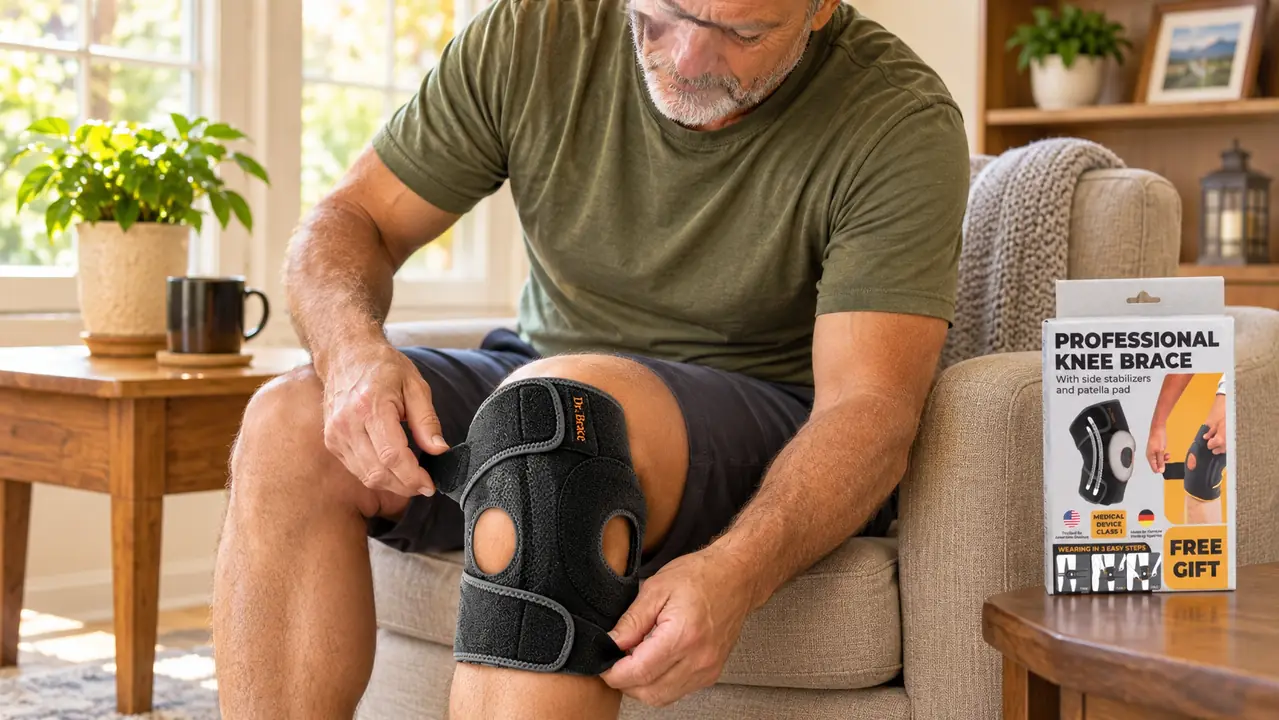
The listing calls them double side stabilizers. In plain terms there are two flexible strips, one down each side of the brace, running from above the knee to below it. They do not lock the joint the way a heavy hinged brace does. They give a little, then resist. If I step wrong and my knee wants to drift inward, I feel the strip on that side catch it. The same in the other direction. For a knee that has become unreliable rather than unstable, that is about the right amount of help. It is also why I can wear this thing for two hours and forget I have it on.
Here is what that feels like in practice. In May I was carrying a flat of pansies across the yard, not watching where I was putting my feet, and my right heel came down on the edge of a paving stone at an angle. A year ago that would have been the end of my afternoon, sitting in the grass waiting for the knee to settle down. This time I felt the strip on the outside of the knee go taut, my leg steadied, and I kept walking to the flower bed. It did not stop the twist. It slowed it down enough that my own muscles could catch up. That is the honest description of what a flexible stabilizer does, and I do not think anyone selling one will put it that plainly.
I want to be honest about the limits of that. If your knee gives out without warning, folds under you, or has a torn ligament your doctor has not cleared, this is not the brace for that conversation. The specifications list arthritis, minor ligament trouble, meniscus issues, patella tracking and general medial and lateral support as the intended uses, and I think the word minor is doing real work in that sentence. A brace with flexible side strips is a helper, not a joint replacement. Mine is holding up a knee that is worn, not one that is broken.
The gel pad around the kneecap is the other piece I did not expect to care about. It sits in a ring over the front of the knee and keeps the fabric from pressing directly on the sore spot. On the days my knee is puffy, that ring is the difference between wearing the brace and taking it off after twenty minutes. The inside also has silicone strips that keep the thing from sliding down my leg, which was the exact failure of the drugstore sleeve. In three months of use I have not once had to stop and haul it back up.
The brace does not make the ache go away. It makes the ache arrive later. I walked a mile and a quarter and got home before my knee started talking to me.
The Parts of the Listing I Had to Read Twice
The box comes with more than the brace. There is a rubber band and a printed weekly exercise program for stronger knees. I nearly threw both away and I am glad I did not. The program is nothing remarkable, mostly seated leg extensions and gentle quad sets, the same sort of thing my physical therapist had me doing years ago. But having it printed on a card in the box meant I actually did it for a few weeks instead of meaning to. To be clear, the brace does not strengthen anything. The exercises are what strengthen things. The brace just makes the days in between more comfortable while you do them.
The material breakdown is worth knowing if you have sensitive skin. The brace is a blend of nylon, polyester, neoprene and spandex, with silicone in the grippy parts and the springs in the side strips. Neoprene is the reason it holds warmth and also the reason it can get ripe after a few wears. I wash mine by hand on Saturday and let it dry flat on a towel, and that has kept it from smelling like a gym bag. If you have ever reacted badly to neoprene, this is the same family of material and you should know that going in.
The fabric is breathable, as claimed, but breathable is a relative word when you are wrapping a joint. In April and October it is pleasant. In an Ohio July it is a warm band around your leg, and I leave it in the drawer unless I am doing something specific. That is not a defect. It is what a padded brace is. I would rather have the padding in March than a thinner brace that does less.
What I Liked
- Two flexible side strips catch a knee that drifts, without the bulk of a hinged brace
- Gel ring over the kneecap keeps pressure off the sore spot on puffy days
- Silicone strips inside mean it stays where you put it, no rolling down the leg
- Adjustable straps let me loosen it after an hour without taking it off
- Came with a printed weekly exercise program I actually used
Where It Falls Short
- Takes two hands and some patience to put on, not something you do standing in a hallway
- Neoprene holds heat, so it is uncomfortable in hot weather
- Needs hand washing and air drying, so plan your week around it
- Not a substitute for a rigid hinged brace if your knee is genuinely unstable
Where It Falls Short
Putting it on is the worst part. There are straps to feed through and tighten, and the whole thing needs to be positioned before you pull anything snug, which means you cannot do it one-handed and you cannot really do it standing up. I sit on the edge of the bed and take my time. The first week this annoyed me every single morning. By the third week I had a routine and it takes about thirty seconds. But if you have arthritis in your hands as well as your knees, this is a real consideration and I will not pretend otherwise.
There is also an order to it that nobody hands you on a card. Each strap has to be threaded and then pulled back on itself, and the first dozen times I did it wrong. I would start at the top, get it too tight, and end up with the brace riding up my thigh like a pair of socks that will not stay. What works for me is the bottom straps first, snug but not tight, then the gel ring settled over the kneecap, then the top straps last. It sounds fussy written down. Done in that order it takes half a minute and the brace sits where it is supposed to sit all morning.
The other thing I will say plainly is that I almost sent it back in the first week. The brace felt stiff and foreign and I was sure I had wasted my money. What changed was not the brace. What changed was that I stopped wearing it for twenty minutes and started wearing it for the length of an actual activity. A brace you take off before it has done anything is just an expensive sock. If you try it, give it a full week of real use before you decide.

Sizing, Straps and Getting It On
Mine fits my leg, which is not a small thing because I ordered without measuring properly and got lucky. Measure your thigh circumference before you order, not your waist and not your height. The straps are adjustable and give you room in both directions, so a slightly wrong size is survivable. But get the measurement close. A brace that is too big will slide no matter how tight you pull it, and a brace that is too tight is one you will stop wearing by Thursday.
The straps also let me do something I did not expect. On a long afternoon I start with everything snug for the walk, then loosen the top strap by an inch while I am sitting in my recliner. That is enough to stop it feeling like a tourniquet and still keeps the side strips where they belong. I do not think the manufacturer intended it as a two-stage fit, but it works, and it is why I can wear this for three or four hours instead of one.
Cleaning is the other routine. The instructions say hand wash, and hand wash is right. I use a little mild soap in the bathroom sink, rinse it, press it between two towels and lay it flat over the shower rail overnight. It is dry by morning. I would not put it in the machine and I would not put it in the dryer, because the neoprene and the side springs are the two things you do not want cooked or tumbled. It is ten minutes of fiddling on a Saturday and then you forget about it for a week.
One more practical note. The brace is meant for walking and daily activity, and the specifications say as much. I have worn it to the grocery, up and down my own stairs, around the garden and to church. I have not worn it for anything athletic and I would not. This is a brace for getting through your day, not for taking up tennis at sixty-seven. If you are looking for something to wear during actual sport, look at what people wear during actual sport.
Who This Is For
This brace is for someone like me. An achy knee with mild to moderate arthritis, worse on stairs and after long walks, that has become unreliable enough to make you plan your day around it. It is for the person who wants to keep gardening, keep walking the neighborhood, keep getting down on the floor with a four-year-old and back up again, and who is not ready for, or does not need, a rigid hinged brace. If that describes you, and your doctor or physical therapist agrees that a soft brace with side support is appropriate, this one is well made and it stays where you put it.
Who Should Skip It
Skip it if your knee is genuinely unstable, if it buckles without warning, if you have had a ligament injury that has not been assessed, or if a surgeon or therapist has told you that you need rigid hinges. Skip it if heat is a problem for you, or if your hands cannot manage straps first thing in the morning. And skip it if you are expecting the brace itself to build strength. It will not. It supports a knee. The exercises in the box and the ones your physical therapist gives you are what do the strengthening. Nobody selling a brace wants to lead with that, but it is true, and you should hear it before you buy.
If your knee is making your decisions for you, start here
The DR. BRACE Elite is the one I put on before the stairs, the garden and the grandchildren. Check today's price on Amazon, and ask your doctor or physical therapist whether a soft brace with side support is right for your knee.
Amazon Check Today's Price on Amazon →